
A M D G
BEAUMONT UNION REVIEW
SUMMER 2026
 In this Editorial, I’m not going to
dwell on The Garden Party as there is plenty later on in The Review but I know
there was concern that our description as “The Last Hurrah” might mean that was
the end of further gatherings. That of course is not the case. The vast
majority of us are unlikely to be around for any future milestone dates for the
College or the B U but while we can, we will continue as best we can to carry
on even as numbers become depleted. So next up is The LUNCH on the Monday 5th
October at The Caledonian Club. I Emailed all and sundry to see if the
numbers would continue to hold up - I’m glad to say its looking good and thank
you all for penning me a reply. The Format for Remembrance Sunday 8th
November will depend upon finding a priest to celebrate Mass for us but
despite the difficulties we remain hopeful: down but not yet out. As I
mentioned to several, the BU can be likened to Peter Sellers in the 1966 (
appropriate year) film “The Party” playing the role of the Indian Bugler
refusing to die: perhaps today the BU should be known as the “Gunga Dins”
In this Editorial, I’m not going to
dwell on The Garden Party as there is plenty later on in The Review but I know
there was concern that our description as “The Last Hurrah” might mean that was
the end of further gatherings. That of course is not the case. The vast
majority of us are unlikely to be around for any future milestone dates for the
College or the B U but while we can, we will continue as best we can to carry
on even as numbers become depleted. So next up is The LUNCH on the Monday 5th
October at The Caledonian Club. I Emailed all and sundry to see if the
numbers would continue to hold up - I’m glad to say its looking good and thank
you all for penning me a reply. The Format for Remembrance Sunday 8th
November will depend upon finding a priest to celebrate Mass for us but
despite the difficulties we remain hopeful: down but not yet out. As I
mentioned to several, the BU can be likened to Peter Sellers in the 1966 (
appropriate year) film “The Party” playing the role of the Indian Bugler
refusing to die: perhaps today the BU should be known as the “Gunga Dins”
NOTICES
THE LUNCH
The LUNCH will take place at the Caledonian Club, Halkin Street, Monday 5th October. The Bar will open at Noon, Lunch at 1pm. Dress: Suits. The Committee looks forward to seeing you all again. You may of course bring your sons and other male guests whose misfortune was not to have attended Beaumont.
REMEMBER.
BACS payment preferred to Sort: 30-99-09. Beaumont Union A/c 02198243 with NAME as reference. The cost is £95. (no increase on last year).
There is no charge for members of the Clergy.
Cheques to The Hon Secretary at the address below. Alternatively, if you have paid electronically you must email to: amanda@mbarrington.net
Mrs A Bedford
94 Hurst Park Road
TWYFORD
Berkshire
RG10 0EY
Tel: 0118 934 2110
NEWS
The “Last Hurrah”
THE BEAUMONT UNION
150th ANNIVERSARY MASS & GARDEN PARTY
FRIDAY 22nd MAY 2026
Well the party is over – ‘the Last Hurrah’ been and gone and from those that wrote afterwards I gathered you thoroughly enjoyed yourselves. Of course, it would have been marvellous if more of you had been able to come but distance, age and infirmity has taken its toll but I’m certain you were with us in spirit. We are grateful to those that sent contributions: Peter Bicknell, George Stanton, David Collingwood, Colin Glennie and Mark O’Sullivan.
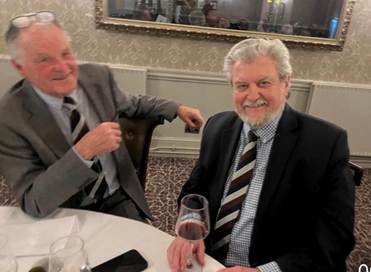
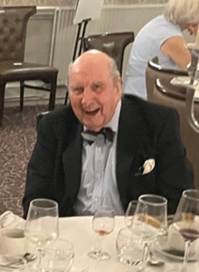
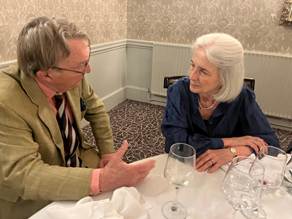
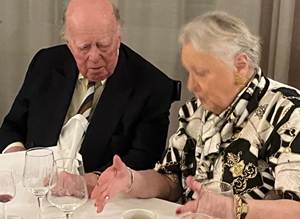
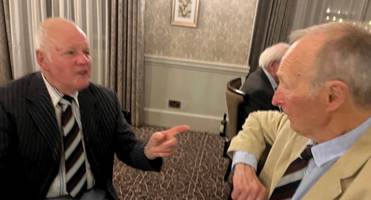
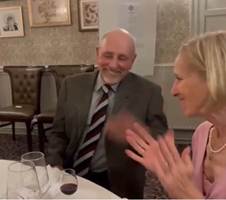
We were blessed with glorious weather and the sun shone and a fair number made overnight stays with a dinner party on each evening in what we remember as the J’s dining room; John Flood’s organisation was on display.
Dinner Party (Night before)
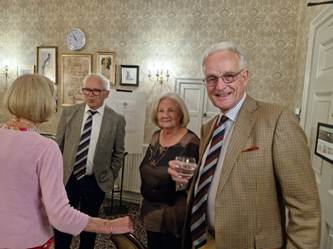
“Maître d' John Flood”
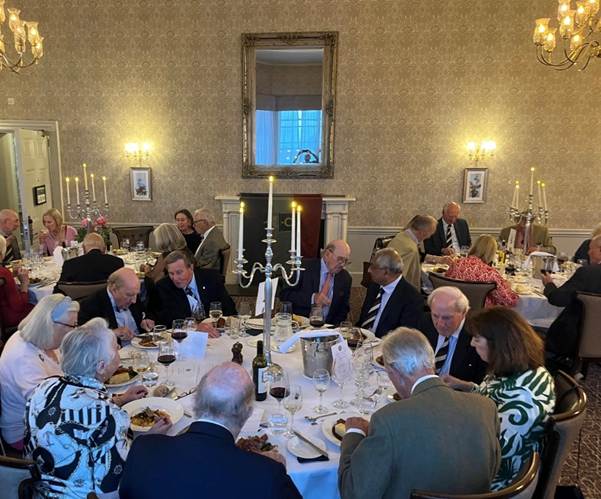
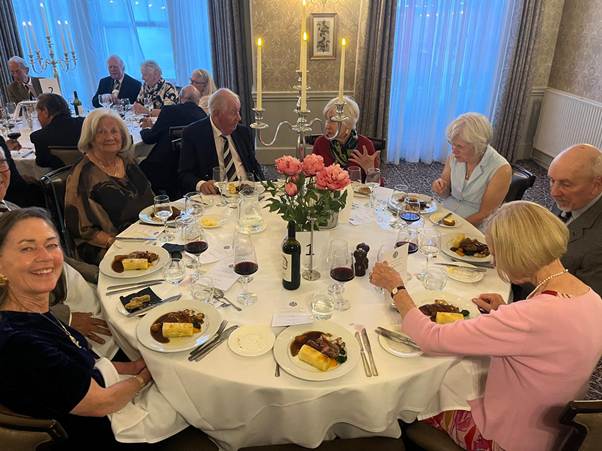
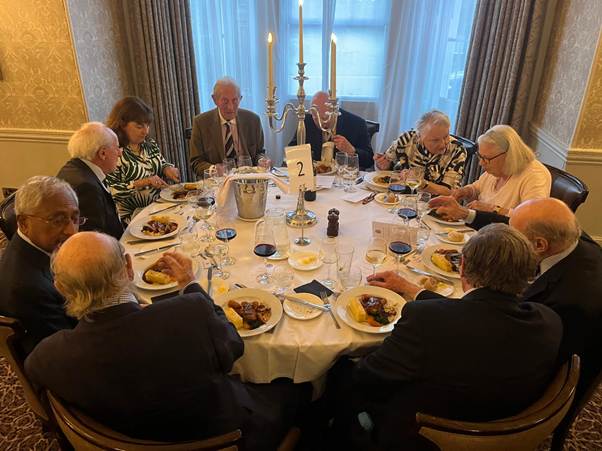
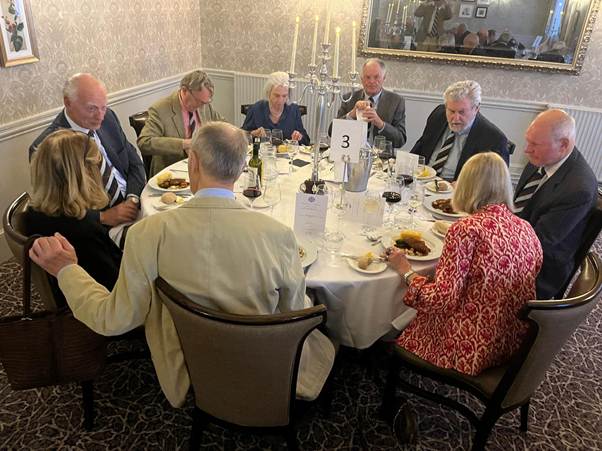
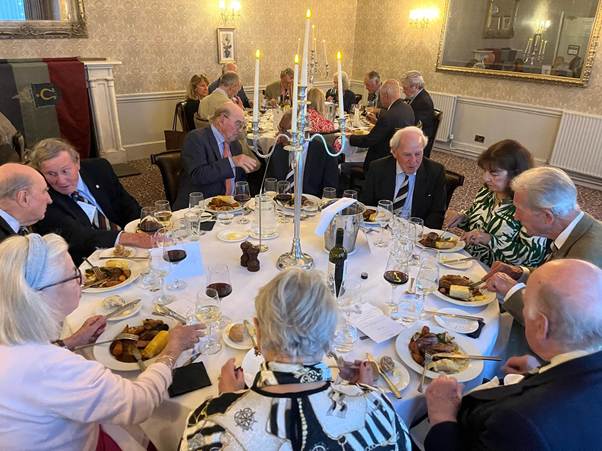
“OVER NIGHT “
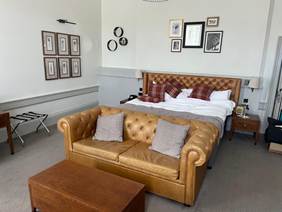

It is hard to believe that this is now the White House accommodation.
“FEAST DAY”
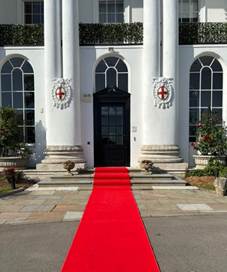
De Vere rolled out the Red Carpet for us
( as we sang in Iolanthe “ Bow, Bow, you lower middle classes”)
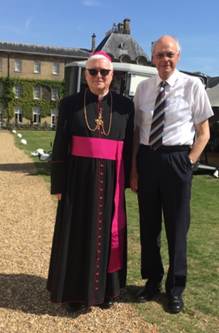
Some 120 gathered (70 OBs) in the old Chapel on the Friday for the Mass organised impeccably by Chris Tailby. We were so fortunate to have Bishop Jim Curry, who has become such a friend to the BU in the last few years with us together with OB Dom Gregory Corcoran OSB having made the trip from Quarr Abbey on the Isle of Wight.
The MASS in the Old CHAPEL
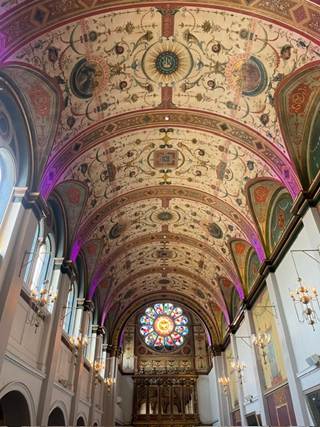
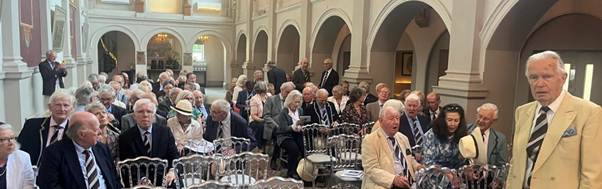
“The Gathering”
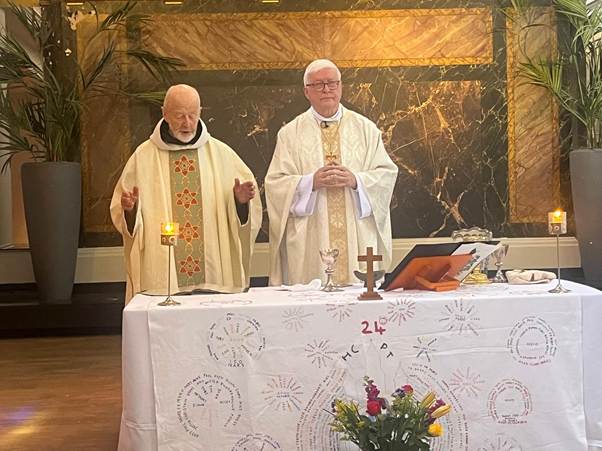
Dom Gregory and Bishop Jim (The Glennie Flowers at the front)
To be honest I expected that our singing would be ‘a bit worn out’ : doubting Thomas. – Chesterton’s “O God of Earth and Altar” came ringing down the years. With ‘Gusto’ as Chris McHugh described it but I would add with a rhythm that continued with the “Gloria, Our Pater Noster, Hail Queen of Heaven and The Carmen”. I think Fr Fizz and Tommy Clayton would have smiled and I half expected Boellmann’s Toccata to coming booming from a long departed organ loft. Bishop Jim’s Homily ‘hit the right spot’ - his observed summary of the Union past and present and its role was uplifting and naturally many of you wanted it in The REVIEW – so here it is:-
B U HOMILY
Homily given by The Rt Revd James Curry, Auxiliary bishop of Westminster. On the 150th Anniversary of the founding of The Beaumont Union May 15th. 2026 .At the Beaumont Estate Old Windsor.
Acts 18:9-18 John 15:917
“150 years is worth celebrating. I know today there will be a complex mix of emotions. How could it be otherwise? Friendships recalled, memories stirred, and a remembrance of those who are no longer with us and who shaped our lives.
The Beaumont Union began as a close brotherhood marked by, among other things, a passion for sport, gatherings, and shared life at the alma mater. The Union was marked also by the world’s rough realism: wars, loss of young lives, and later the closure of the College.
That closure could have ended everything. It could have produced only anger—at what was lost, an intense sense of trust betrayed, and the feeling that the Union had been left holding an empty shell.
In the Word of God given to us in today’s Mass, we see two men facing pressure from every direction: Paul before royal authority in Caesarea, and Peter restored to his mission by the risen Lord.
And in both scenes, the question is the same, even if it is asked differently: Will you continue to love God and neighbour when it costs you something?
The Beaumont’s story resonates with these texts and the question posed.
The Gospel message reminds us that love is proved when it is tested, not when everything is secure. In the life, death and Resurrection of Christ, Jesus proves love by redirecting love’s purposes. Death becomes the seedbed of life.
So, Paul’s love for Christ becomes witness, even under custody and delay.
And Peter’s love for Christ 'food for others', even after failure and pain, when Jesus asks Peter, again and again, “Do you love me?”—until love is turned into service.
When the Beaumont Union, rather than shrinking into grief, found a new outlet for love in action, with the beginning of HCPT, the story becomes recognisably Christian: a brotherhood becomes a shepherding mission of care and giving, love redirected and expressed.
You are no doubt familiar with the phrases “hands on” and “hands in prayer.” It is a common temptation to think they belong to different worlds: one busy and practical, the other quiet and spiritual. They actually belong together. They need each other.
The BU survived shock and loss and found a renewed purpose—answering God’s call to love with charity in truth. And that, dear friends, is what the Gospel and Church ask of every Christian, whatever our background or season of life.
At the heart of Christianity is not simply an emotion, nor even a vague sense of doing good, but the theological virtue by which we love God above all things, and our neighbour as ourselves for the love of God.
Put simply, Christian charity is not whatever we happen to feel like doing. It is love that becomes real in concrete good because it is rooted in Christ, who is Truth: giving to the least of those who are our sisters and brothers.
This reality is not a private sentiment. It shapes all our action. Jesus makes charity the new commandment—“that you love one another as I have loved you”—and this love is meant to go “to the end,” to imitate the way Christ loves.
In your enjoyment of convivial sport and fellowship, you were already expressing a profound good: belonging, loyalty, sacrifice, friendship, and a shared discipline.
The story you tell and cherish is more than nostalgia for old friendships. It’s the account of how a community learned that fellowship needs to become service if it is to remain Christian, to remain alive.
And that is exactly the turning point your story describes: after the College closed—after a loss that could have produced endless resentment, withdrawal, or bitterness—the Union found that its mission would either shrink into grief or grow into charity.
The closure of the school could have made the Union feel pointless. No other Old Boy organisation suffered such a blow, and many understandably felt anger and hurt. Yet your bonds of friendship, shared experience and loyalty to what was good in all you held in common triumphed.
This triumph was not built on the instinct to protect yourself. It was and is built on the logic of the Cross: love perseveres through loss, and it finds a way to keep giving.
A God-given new opportunity came in a fortuitous beginning: in 1956, a young doctor, Michael Strode, took three disadvantaged children to Lourdes, and that moment blossomed into HCPT. And at the very beginning, both Old Boys and the school became involved.
That detail is a sermon in itself. Charity often begins small: sometimes with only a few people, sometimes with a single journey, sometimes with a “yes” that doesn’t look like much at first.
Yet caritas, love in action, is creative and redemptive, poured into our hearts and made present through Christ. A brotherhood that had once been defined by uniformity of experience—school, sport, gatherings—was redefined by compassion.
The Union did not become irrelevant; it became transformed.
Your history is marked too by another loyalty and striking reality: war and all it asks and takes. Many Old Boys spent part of their lives and died in uniform, in service of others and defence of hard-won freedoms. They demonstrated a willingness to carry burdens for the sake of others.
The fine Gilbert Scott war memorial stands as a precious and poignant memorial to them all. A number of you also served in uniform, and many of you will have experience of the OTC, a shared experience of discipline and obedience to duty.
A Jesuit might ask the question: What are you training for? The story of the Beaumont Union answers that question by pointing to a deeper uniform than any military one: a life willing to give in service to others.
The Church describes the Christian community as one body with many members—each member indispensable, each called to care for the others. That means service is not optional decoration. It is the proper rhythm of a body that wants to live. From fellowship to service.
150 years is worth celebrating. Friends, nothing stands still; we are always moving forward. Will the spotless, flawless name of Beaumont—Nomen Beaumontanum—be remembered? Of course it will, whenever your names are recalled; remembered in the colours of the Beaumont Rugby HCPT region shirt; remembered by those who loved, love, and admire you. Wherever a glass is raised or a prayer is said for you at the war memorial, in a parish church, or in the grotto at Lourdes, you live on—and in the great eternal heart of the God of Jesus Christ, always.
For we are defined by Aeterna non caduca — “The eternal, not the passing.”
As I conclude, your story gives one of the best theological insights: the Union might be “superfluous” to its original beginnings, but others needed them more—so they answered the call from “hands on” to “hands in prayer.”
That phrase matters, because it shows charity is not only activity; it is also intercession, patience, and sacrificial spiritual solidarity.
When you do that, when you blend “hands on” with “hands in prayer,” you become the kind of community Beaumont found after its loss: a brotherhood whose members can say, in effect, “Whatever the origin, we exist for others now.”
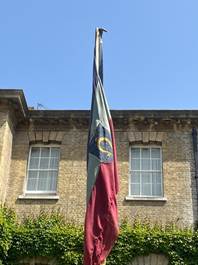
The Flag “Flew” - well, it was hot and not much breeze
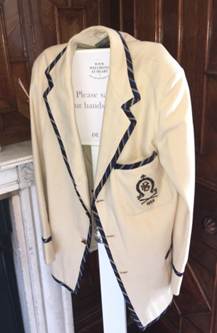
Formal and informal wear. The Clasen -Blazer
Only one ever awarded for Sculling
Out onto the lawns to find that De Vere had found a suitable flag pole and the flag flew once more as the Champagne flowed and the canapes enjoyed, friends met up and acquittances renewed after many a year. A few relics had escaped the moth and came out of the wardrobe with Henley Blazers worn by Gerry Ford ( courtesy of Andrew Clasen) Emrys Williams and Charlie Poels. Boating Colours Robert Bruce and Chris McHugh. The only ‘pyjama’ jacket still fitted Stephen Crompton (Capt. 1965) and for boxing Richard Sheehan.
A good number made the ‘pilgrimage’ to our iconic War Memorial, more beautiful than ever bathed in sunshine and to see the Queen’s Centenary Tree still flourishing.
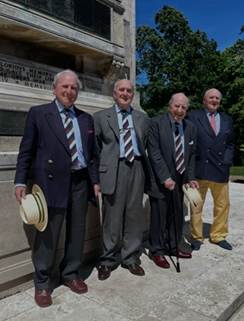
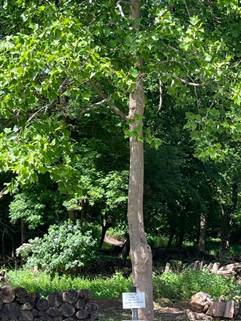
De Lisle ‘family’ Tree. The Queen’s Tree
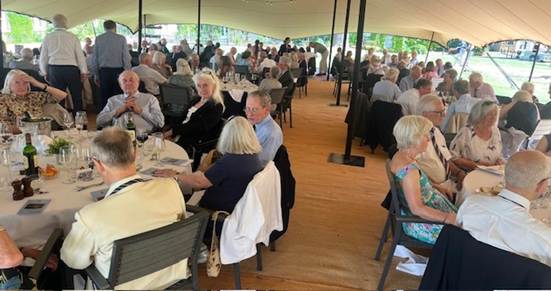
Somehow the table plan ( after many a change) seemed to work and I don’t think anyone found themselves seated with a remembered ‘snotty-faced youth’ of bye-gone years. A change of plan that the buffet was brought to the tables rather than having to stagger elsewhere and meant that conversation remained unbroken and well-oiled by Ch. Beaumont so kindly donated from Derek Hollamby’s cellar.
Hugh Wooldridge (67) turned up unexpectedly but most welcome, bearing a couple of bugles complete with Beaumont ‘cords’ which we auctioned and in a bidding war between Konrad Wallerstein, Tony Outred and Gerard de Lisle, the Squire made the clinching bid of £550 raised for H C P T. We gathered that Hugh had ‘purloined’ the bugles on leaving Stonyhurst and the disbandment of their Corps of Drums of which he was Drum Major. Whether this was an indictment on the standard of their music, Hugh’s leadership or the first signs of ‘Defence Cuts’ that have plagued the nation ever since – who knows.
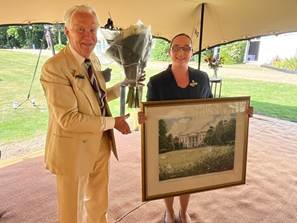
We made a presentation to De Vere for looking after us so well for the party but also for their manner of making the Union so welcome over the years.
The company drifted away in the late afternoon leaving a few die-hards to enjoy a swim and a smaller supper party that evening.
REFRESHER
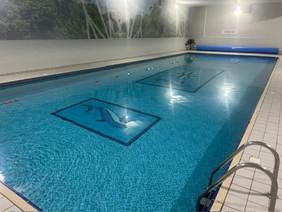
Gone the Victorian tiles, the diving board, and the changing cubicles and the water is somewhat warmer than days of old.
ACCOLADES
I don’t think I can do better than quote below some of the many tributes we have received:-
“ A truly memorable and enjoyable day.”
“ Congratulations on the huge success of the “Last Hurrah.”
It was wonderful to have a few days back at Beaumont reminding me of the times we were there many years ago and indeed to be able to say hello to many old friends and acquaintances.
The programme you arranged was really wonderful and the highlight Congratulations on the huge success of the ”Last Hurrah.”
It was wonderful to have a few days back at Beaumont reminding me of the times we were there many years ago and indeed to be able to say hello to many old friends and acquaintances.
Our hotel accommodation was truly excellent and such good value..
It was really a very memorable couple of days .”
“ We thought that yesterday was a delight as well as a triumph.”
“ May I add the congratulations of my wife and me to you both for the wonderfully well-organised celebratory mass and garden party yesterday. …….. Our thanks also to the managers and staff of De Vere Beaumont who made the whole day pass without a hitch.”
“ Thank you so much for all your efforts in arranging Fridays ‘last hurrah’. I thought everything worked wonderfully and for the best ...Beaumont itself was looking cared for and beautiful; the weather of course could not have been better; the food gave everyone just what they need and the Chateau Beaumont rounded it all off.”
“ The champagne reception with canapés was the opportunity to circulate and meet some long- forgotten friends. The excellent buffet lunch together with Derek Hollamby’s Chateau Beaumont, all under that splendid awning on the Captains’ lawn, was a magical setting. Much thought had gone into the tables and seating plans.”
“ I thought De Vere did us proud, even to the Red Carpet on the Whitehouse steps…… ‘Bravo Zulu’, my friends! Thank you and well done indeed,”
“ What an unforgettable experience yesterday was! Thank you all three for all the work you put in. It was a huge success.”
“Just to express my thanks and gratitude for all the organisation behind the event the Last Hurrah
We did the whole thing staying Thursday and Friday nights,
I met contemporaries I had not seen for 60 years and sat with some at lunch
Their features seemed quite familiar -it was a bit overwhelming .
It brought back a lot of memories where I could write a chapter”
“It was wonderful to have a few days back at Beaumont reminding me of the times we were there many years ago and indeed to be able to say hello to many old friends and acquaintances.
The programme you arranged was really wonderful and the highlight for me was Mass with Bishop Curry.”
I cannot thank you enough for all the effort that both you and the Committee devote to keeping the Spirit of Beaumont alive and kicking. The turnout for the 150th anniversary was extraordinary even by the standards of an existing school, let alone one that closed sixty years ago.
You are all to be complimented for the brilliant organisation of what transpired to be a memorable couple of days. From the excellent Thursday night dinner, so thoughtfully organised by John Flood, to Friday’s main event it was a much reassured opportunity to enjoy the company of so many old acquaintances and their charming wives.
As John Flood ( to whom the accolades were rightly addressed) commented:
“I half expect you to get a whole host of requests to do the same again next year which of course was not the plan!!”
Ed: My verbal adversary ‘Bootneck’ pointed out that an unlikely combination of a ‘Donkey-walloper’s’ broad brush and a lawyer’s attention to detail produced a truly memorable day.
O B ATTENDEES
(55-58) Jeremy Gompertz, Christopher Corcoran, Gerard de Lisle, Nicholas Warren, John Wolff.
(59) John Bokor-Ingram, Philip Critchley, Gerry Ford, Richard Morris, Kevin Ryan, Malcolm Pritchett, Paul Podesta.
(60) Mark Addison, Derek Hollamby, Donald Houlihan, Barrie Martin, Emrys Williams.
(61) Guy Chamberlain, Anthony Chancellor-Weale, Tim FitzGerald-O’Connor, Ed Monaghan, Tony Outred, Charlie Poels.
(62) Francis Beckett, Paul Burden, Oliver Hawkins, James Sweetman, Robert Wilkinson. Francois Neckar.
(63) Patrick Burgess, Gregory Corcoran, Nigel Courtney, Stephen Crompton, Bertie de Lisle, Tony Russell, Richard Sheehan, Bernard Stevens.
(64) Robert Bruce, Michael Burgess, Hubert de Lisle, Christopher McHugh, Anthony Northey.
(65) Romain de Cock, Arthur Cope, John Flood, Michael Newton, Chris Newling-Ward, Mickey Parish, Simon Potter, Michael Wortley.
(66) John Blackwell, Charles Hickey, John Lees, Edwin de Lisle, John Marshall, Mark O’Sullivan, Carl Nicholson, Peter Savundra, Chris Tailby, Konrad Wallerstein, Nigel Cawthorne.
(67) Philip Bingham, Varyl Chamberlain, Gino Ciuffardi, Paul Dutton, David Fettes, Michael Johnson, Philip Noble.
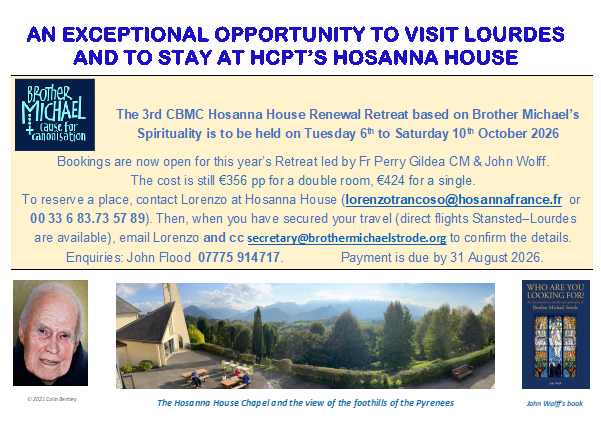
The 3rd CBMC Hosanna House Retreat
After the success of the first two retreats in 2024 & 2025, the Committee for Brother Michael's Cause for his Canonisation has arranged the third retreat starting the day after our BU lunch ( 6th October). The Retreat is based on the spirituality of the founder of HCPT. After his career as the doctor at Chailey Heritage hospital school, Dr Michael became Br Michael when he joined the Cistercian community at Caldey Island. John Wolff (58) will again be one of the retreat leaders. Over the last 70 years 100 OBs have travelled to Lourdes with HCPT. This retreat offers you the opportunity either to revisit Lourdes or to travel there for the first time, staying in HCPT's Hosanna House with its incredible views and excellent catering. There are just a few places remaining.
St Ignatius at Farm Street
The annual mass for Jesuit Alumni was held on St Ignatius’s Feast day 31st July followed by a drinks party in the gardens.
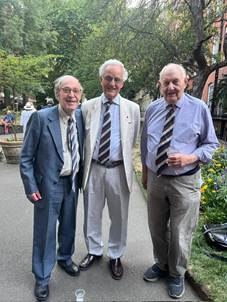
The B U were represented by Jeremy Attlee, John Flood and Francois Neckar.
It should be added that numbers were depleted with the clash of dates with ‘Glorious Goodwood’!
The LAST of the FEW
Ed Anderson CBE (66) stood down as Lord Lieutenant for West Yorkshire in December.
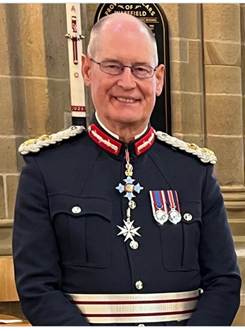
From: Leeds Beckett University
Ed Anderson BSc (Hons) Economics, 1972 was born in Singapore and came to Leeds in 1969 to study at what was then the Leeds College of Commerce which later became Leeds Business School within Leeds Polytechnic.
Over the last 46 years, Ed has enjoyed an illustrious career taking him from President of the Students’ Union to Chief Executive of Leeds Bradford Airport and earlier this year he took on a new role as Lord Lieutenant for West Yorkshire, appointed by The Queen as Her Majesty’s representative in West Yorkshire.
“I remember some of my lecturers, they were very good and it was a very good course.” Ed recalls, thinking back to his time at university. “At the end of my degree, I became the President of the Students’ Union, which was a sabbatical position for one year. I was the fourth president of the Students Union, fourth ever. That gave me a seat on the Board of Governors, which for someone aged 21, was quite something, and it was the experience of being President that stood me in good stead ever after.”
From the Students’ Union, Ed went straight into local government, training as an accountant which took him across several local authorities in the region before joining Leeds Bradford Airport. “I had two spells at Leeds Bradford Airport, one was in the early 80s and then the second, which was my last executive job, where I ran the airport for 10 years as Chief Executive, from 1997 to 2007. I’m very proud of the time I spent at Leeds Bradford Airport as it was during that time that Jet2.com was established at the airport, and it now has over 50 routes across Europe, I’m particularly proud of that.”
Using the experience he’d gained running the airport Ed moved into financial services, taking on the role of Chairman of Yorkshire Building Society for eight years. “Chairing the board of the Yorkshire Building Society through the financial crisis was quite challenging, but we came through it and in very good shape.” He is currently Chairman of National Savings & Investments.
In September Ed was appointed as Lord Lieutenant of West Yorkshire, taking over the role from Dame Ingrid Roscoe who held the position for almost 15 years. Ed is now responsible for arranging visits to West Yorkshire by members of the Royal Family, representing The Queen at events across the county. “There’s quite a few things that all Lord Lieutenants will do, particularly working with the Armed Forces and other uniformed services, a lot of civic and church engagements and then on top of that most Lord Lieutenants want to try and make a difference by encouraging the voluntary sector in the county. There are literally thousands of charities in West Yorkshire, all doing amazing work, every single one of them and I feel like they’re the glue that holds society together. I’d like to do everything possible to support them as organisations and to encourage the notion of volunteering across the county.
“As an alumnus of Leeds Beckett University, I would advise all students and fellow alumni to appreciate the help that people give you throughout your life and take opportunities as they arise which sometimes involves taking some risks, and then secondly, to try and make sure you put something back into society and do some good.”
OBITUARIES (A few more Lost)
I have to sadly inform you of the death of the following:-
Michael Whitehead (67) son of Cecil (20).
Paul Bohane (52), brother of Michael (49) and son of Frank (22)
His Honour Dr Jeremy Connor (56) A loyal supporter of the Union, Barrister, Circuit Judge, Reader of the Middle Temple, and Doctor of Theology. Read more in Giss-Goss of Jeremy and his remarkable partner.
Nickolas Warren (58). Nick died on the 8th August after battling an aggressive cancer over the last few months. It did not stop him ( in his indomitable fashion from attending the “Last Hurrah” although seriously ill. Nick was both at St John’s and Beaumont (He has grandchildren currently at St John’s). At School he Captained both the 2nd XI and 2nd XV. A firm and consistent member of the BU he is especially remembered for producing our CD ‘Hymns of Our Youth’ through his company Aeterna -CD.
Christopher Gardner-Thorpe (59). Christopher trained in medicine at St Thomas’ Hospital in London and then in neurology, holding the post of Consultant Neurologist at the Royal Devon and Exeter Hospital and also working as an independent Consultant Neurologist. He was an expert witness in Court. He lived in Devon for more than half his lifetime and had a wide interest in neurology, including the manifestations of lupus within the nervous system. He enjoyed Dartmoor and spent much time there but also has commitments in teaching medical students in the Exeter University Medical School, mainly in the Humanities – medical history, medicine and the law, and medical writing. He also examined and directed the courses in medical history at the Society of Apothecaries, livery company in London of which he was the President
He was a bibliophile and donated his collection of Historic medical books to the Extensive Library at Exeter Cathedral.
( Christopher’s father Colonel Sir Ronald was Lord Mayor of London 1980-81 and Treasurer of the Liberal Party 1962-65). Again, there is more to be found on Christopher later in The REVIEW.
David Collingwood (61)
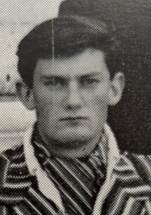
David went through St John’s before Beaumont and played in the 1st XV and the X1 where he earned his colours as wicket Keeper, a role he took on as there was no one else and at which he excelled! He held the Beaumont record for catches behind the wicket – 20 in one seson. He had thought about becoming a doctor but eventually decided on the Army serving in the ranks of the Grenadier Guards before going to Sandhurst . Here he was promoted to the Commandant’s Stick Orderly and Under Officer before his Commission into the 15/19th The King’s Royal Hussars. It was then service in Germany with the Regiment during the 1960’s. Deciding that eventually that military life was not for him, he left and went into finance in the City. He joined the American/British conglomerate of Janus Henderson and eventually retired as one of the UK Directors. Although suffering from the onset of dementia in the last year, he died unexpectedly at the end of July at his home for many years at Hastingleigh near Ashford in Kent.
The Funeral will be held on Monday 7th September, at 2pm at Wye Church TN25 5AE and then afterwards at the house at New Barn Farm. TN25 5HJ. Please let me know if you are attending so that I can let the family know.
Peter Burden (65)
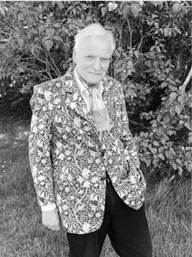
Peter Burden (65), died on the 8th August. He was the younger brother of Paul (62) and also a nephew of Hugh the actor and with the same gene that included, Shelley, George Bernard Shaw and Mrs Patrick Campbell amongst his ancestry.
Peter was, in his own words, a precocious youth of the Sixties, when the culture of the Country altered more radically than it did after both World Wars, and for Catholics, there were those changes brought about by the Second Vatican Council. Burden claims his talents ranged from smoking in the college woodlands, engaging with local females and playing guitar in an appalling but inexplicably popular band - in fact not very different from several of his contemporaries at the time. Having spent part of his early career involved in design and fashion including launching a marque of jeans called “Midnight Blue” he wrote a highly successful book on the rag trade; “Rags – a splendidly lively whiz through the fringes of the swinging Sixties”, it made the Sunday Times best seller list and Peter had found his true metier. Other authorship included the biographies of the actor David Hemmings and the cricketer Ted Dexter. In the context of racing, Peter wrote eight thrillers with John Francome, the one time champion National Hunt jockey and three others with Jenny Pitman the first lady to train a National winner with Corbiere in 1983. Both these successful authors owe a great deal to Peter’s talents for he transformed their equestrian experiences to a world of fiction.
Later in life he became Mr Pernickety – the anonymous food critic especially of the gastronomy available in his local; town of Ludlow.
Also see OBITUARIES
BOOK Sales
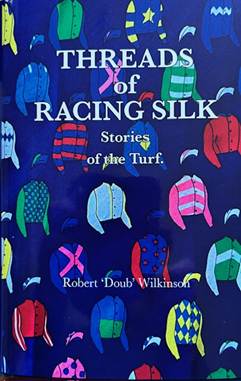
A big THANK YOU to those who bought my book at the Garden Party on Beaumont’s connection to the Turf – since then I’m almost sold out!
HUGH’S next SHOW
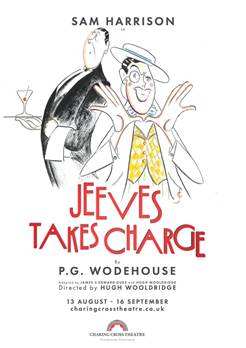
First seen 45 years ago, the Olivier Award-winning and much-loved Jeeves Takes Charge returns to London for a short season at the Charing Cross Theatre after showcase productions at the Jermyn Street Theatre (“Brilliant” – Jeffrey Archer), The Tabard Theatre (“How on earth does he do that?” – Trevor Nunn), and a Christmas season at the Theatre Royal, Bath (“One of this year’s Top 20 Christmas shows – The Guardian.) West End, Chichester and RSC favourite, Sam Harrison, plays all twenty-two much-loved PG Wodehouse characters including Jeeves, Wooster, Florence Craye, Gussie Fink-Nottle, Bingo Little, Uncle Willoughby, Aunt Dahlia, and many more – in a bravura, tour de force, one-man performance.
Originally brought into the West End by Barbara Dickson and Bernard Theobald, together with Cameron Mackintosh and Andrew Lloyd Webber, Jeeves Takes Charge is guaranteed to put a smile on your face and a song in your heart.
Do not miss this dazzling and extraordinary, strictly limited, run. Pip Pip!
by PG Wodehouse
Adapted
by James and Edward Duke, Hugh Wooldridge
Lighting by Tim Mitchell
Sound by Paul Groothuis
Design by Caite Hevner
Directed by Hugh Wooldridge
Produced by Steven M. Levy for Charing Cross Theatre Productions LTD.
As mentioned earlier Hugh’s 2 Bugles from the Corps were auctioned at the Last Hurrah and raised £550 for HCPT.
A FIRST
I’m grateful to John Marshall over in The States for bringing my attention to a “Beaumont First” – an unexpected rarity these days. Peter Hammill (66), considered by many to be one of the top progressive rock performers in the Country made his debut at the BBC PROMS.
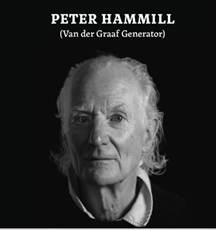
The publicity:-
“The BBC Proms season is underway again and just as in recent years, the range of the music on offer is a tribute to the imagination, skill and sometimes, yes, the courage of the programmers of what is widely regarded as the world’s greatest music festival.
Saturday’s Prom was titled Prog Rock: A Fanfare for the Common Man. Back in the heady days of the late 1960s and early-to-mid 70s, Prog(ressive Rock) was music unconstrained by established forms and conventions of blues, rhythm and blues, or folk music, although it often contained elements of these – and other genres including jazz.”
Others performing included GENESIS and Mike Oldfield Apparently, Peter at 77 stole the show as the REVIEWS informed us.
“Peter Hammill at the BBC Prog Prom a half hour ago, where he absolutely brought the house down with his vocal perf on "Refugees". The BBC radio announcer said there wasn't a dry eye in the house, and the applause was thunderous and long.”
“The evening's greatest luxury comes courtesy of the one man singing his own song. Peter Hammill, gravel-throated founder of Van der Graaf Generator, gives "Refugees" its full melancholy weight and leaves every other singer in the building looking like a tribute act. Which, of course, is precisely what they are.”
“The master of powerfully emotional vocals. Almost operatic in his vocal range.
A great singer and a fantastic songwriter.
Van Der Graaf Generator will always be one of the greatest progressive rock bands ever.”
“HAMMILL JUST NAILED IT AT THE PROG PROM!!! LONGEST APPLAUSE OF THE NIGHT WHEN HE WALKED OUT, AND THUNDEROUS AFTERWARDS! HE SOUNDED GREAT AND THE RADIO ANNOUNCER SAID THERE WASN'T A DRY EYE IN THE HOUSE!!!!”
Peter’s CV can be found naturally on The WEB including Wikimedia but his time at Beaumont was spent as follows:
St John’s Beaumont: Date of entry – unknown .1960/61 Class Prize 9 senior Year. ½ Colour Boxing, Cricket XI (photo attached)
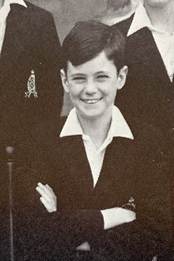
Vice -Captain of the school (presented to the Queen during her visit to Beaumont in May 1961).
Beaumont. Entered Sept. 1961 in the “A” Stream.
1962 sang the role of Patience in Gilbert & Sullivan Operetta
1963 Lower Line school play ( Boys up to 16) “ gave a delightful and uninhibited performance” as The Pageant Master in The Town that would have a Pageant by Du Garde Peach.
1965 & 66 Maths prize. 3rd XV Rugby. 3rd XI Cricket, the Schismatics ,and awarded his “Gollywog”. Other interests : CCF L/ Cpl ( obviously not a soldier)
Scouts, Motor, Music, Debating. Quodlibetarians. Started a new society the 231 Chorus.
ARTICLES
AMERICAN TITTLE-TATTLE 1920s
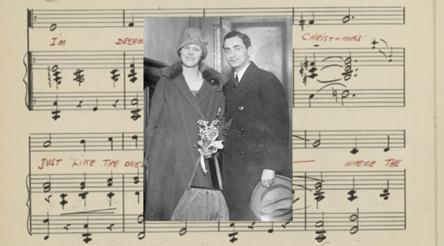
Bain News Service via Library of Congress/Wikipedia
Irving Berlin and Ellin Mackay daughter of Clarence (92) put aside their differences in culture, background, and age to form one of the best-known, enduring and loving relationships in New York social history. At the same time, the stories of the Berlin and Mackay families, which both started with brave immigrants taking a chance in America, are not so different as they first appear.
Their whirlwind romance caused a media feeding frenzy on both coasts and extended as far as Europe, keeping the paparazzi in flashbulbs for over a year. Their semi-clandestine affair was aided by several unlikely sources, from the bride’s estranged mother to the Prince of Wales. They evaded the ever-present press by eloping to New York’s City Hall on January 4, 1926, not using his chauffeured Minerva limousine, which was constantly followed, but by taking the subway – a first for the young heiress. Their 10-minute wedding ceremony led to years of controversy for the couple, who ultimately became one of the great love and success stories of the twentieth century. Their love endured for 62 years, ending only in 1988 with the death of Ellin Mackay, wife of Irving Berlin.
Many parallels can be found in the widely differing histories of the Mackay and Berlin families, especially between those of Irving Berlin and John Mackay, Ellin’s grandfather. Both started out in similar circumstances, in abject poverty in 19th-century Europe. John Mackay was born on November 28, 1831, a product of the slums of Dublin, Ireland, about as humble a beginning as one could imagine at the time. Approximately sixty years later, in a very different but equally impoverished part of Europe, six-year-old Irving Berlin (then called Israel Baline) watched the only home he had ever known, located in the Jewish ghetto, burn to the ground at the hands of the Russian Cossacks. The Baline family: father, mother, and seven children fled with only the clothes on their backs. They miraculously wound their way through Europe and finally landed in New York City. In 1840, at age nine, John Mackay also immigrated with his parents and a sister to New York City. Mackay pére died shortly thereafter, plunging the remaining family members into extreme poverty.
As a child, John Mackay sold newspapers to help support his mother and sister. As soon as he was old enough to work, he got a job in a shipyard, but at age twenty he left for California to try his luck in gold mining. Similarly, Irving Berlin lost his father, a cantor, at a young age. As the oldest boy in the family he also first sold newspapers but then left school and took a job as a singing waiter at Mike Salter’s Chinatown bar to support his mother and siblings. There he co-wrote, with another singing waiter, his first song – “Marie From Sunny Italy.”
Out West, John Mackay struggled in vain to find gold. Unfortunately, but not unexpectedly, he found very little and soon left for Virginia City, Nevada. There he teamed up with three other Irishmen (James Graham Fair, James C. Flood, and William S. O’Brien) to form a mining corporation. The partners did achieve initial success in gold and silver, enough to make them all millionaires. But their 1873 discovery of the single largest lode of silver ore in the world, eventually known as the Comstock Lode, earned them the name The Silver Kings. They found it by digging down over a thousand feet in the Virginia Range, at Mackay’s insistence. The amount of silver was later described by a journalist as equal to the size of New York’s City Hall Park (8.8 acres) and rising 120 feet. Although estimates vary, by the time the ore was exhausted it had yielded at least $190,000,000 worth of silver. It made Mackay wealthy beyond his wildest dreams.
Irving Berlin had his own version of the Comstock Lode with the song “Alexander’s Ragtime Band,” which catapulted him into a lifetime of artistic and financial success. With his first surge in income he bought a house in the Bronx (then a fashionable suburb of New York City) for his mother. Although he never learned to read or write music, Berlin found his niche in writing popular songs – he would compose the melody by ear and hire someone to write it out for him. While Irving achieved success early in his career, he continually struggled to stay on top. Although the term was not coined in his day, he could be described as a classic workaholic. His work habits were unusual in that he would stay up all night working and then sleep until noon. This led to one of his most popular songs, describing his experience in the army in World War I: “Oh, How I Hate To Get Up in The Morning.”
John Mackay was a quiet, polite, hardworking man, who sometimes spoke with a slight stutter. The statue of him in front of the Mackay School of Earth Sciences and Engineering at the University of Nevada, by sculptor Gutzon Borglum of Mount Rushmore fame, depicts a sinewy, muscular man in miner’s clothes. He was a liberally minded Roman Catholic, and also a member of the Freemasons. This membership led indirectly to his marriage.
Louise Antoinette Hungerford was born in New York City but came out West as a child with her parents, who were searching for a way out of their own poverty. At sixteen she married a doctor and the future looked promising until he succumbed to alcoholism and drug abuse and died at a young age. Since the doctor was a member of the same Masonic Lodge as John Mackay, he and two others visited the widow after her husband’s death, bringing with them a gift of money to tide her over during the difficult time. Louise politely declined their offer on the grounds that she could not accept charity and that, although she had a young daughter, she was determined to somehow manage on her own. John felt he could not let a beautiful woman with that kind of character get away. On November 27, 1866 John William Mackay and Louise Antoinette Hungerford Bryant were married in Virginia City, Nevada by the Rev. Father Manogue, a personal friend of both.
Louise moved into a much more comfortable existence than she had ever known. John proved to be extremely generous with his newfound wealth and treated his little stepdaughter as if she were his own, eventually legally adopting her. The Mackays moved into a comfortable house in San Francisco, where their first son, John William, Jr. was born in 1870. They lived quietly and happily in San Francisco, with John gradually becoming more of a corporate miner, although he still often supervised his mining operations personally. He also expanded into banking. When the big silver was struck, their lives changed forever. They were soon one of the richest families in America. John became the Bill Gates or Michael Bloomberg of his day. He turned to philanthropy, founding a Catholic orphanage in Virginia City and the Opera House in San Francisco, among many other works.
Louise wanted to return to her native New York City and enter society, but their ethnicity and religion – more so than their nouveau riche status – stood in their way. Louise could be reluctantly accepted as a Catholic since she was of French and English descent, but social status for the wife of an Irish Catholic was out of the question. In Silver Platter, her biography of her grandmother, Ellin Mackay Berlin quotes one of the New York snobs as saying: “Mackay? Oh Irish, of course. They don’t even pronounce it properly.” (John pronounced his name MACK-ee as opposed to the Scottish pronunciation of mac-KAY.) Furious at the treatment accorded his wife, John packed up his family and moved to Paris where he bought one of the city’s largest mansions, and Louise soon became one of the most popular hostesses in Parisian society. They then rented a second house in London and became friends with the upper echelons of English society. John would leave his family in Paris or London and commute across the Atlantic to take care of his now-expanding business empire.
Despite his wealth and success, John never lost his grit or moral compass. At one point, one of the infamous London tabloids tried to dig up dirt on the Mackays, targeting Louise in particular, accusing her of being a former “washer woman.” Though a seamstress and embroiderer in her youth she never actually took in wash, although neither honest occupation is anything to be ashamed of. John hired detectives to find the source of the rumour and when he located the cad, an unsuccessful businessman, in one of the banks of which Mackay was a director, he confronted him. Although several years the man’s senior, the still muscular fifty-nine year old Mackay punched him twice in the face. He then challenged him to a fistfight, which the hapless slanderer wisely declined from his position on the floor. The Mackays sued the tabloid, won a large financial settlement, and donated it all to charity. In a later unfortunate incident, a failed miner unreasonably blamed John for his bad luck and shot him. The bullet went into his chest and out his back, but John survived.
John William, Jr (88) was expected to take over his father’s enterprises, which grew to include the Postal Telegraph Company following one of his father’s major accomplishments: the laying of the second Atlantic Cable, by which he drastically reduced the price of telegraphic communications between the United States and Europe. However, tragedy stuck when young John was killed in a horse racing accident. His parents wanted him laid to rest in New York City and began the construction of what was, and still is, one of the most elaborate mausoleums in Brooklyn’s Green-Wood Cemetery. It is the only one built with electricity and a heating system so that the priests who prayed for John, Jr. (and ultimately the rest of the family) would be comfortable. A fund, which survives to this day, was set up to cover the costs.
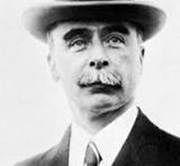
Back in New York with second son Clarence (92) set to take over the vast Mackay empire, they bought a townhouse at 3 East 75th Street in Manhattan’s Upper East Side. When Clarence met and fell in love with a beautiful society heiress named Katherine Duer, John built them a 50-room mansion on Long Island’s North Shore as a wedding present. Named Harbor Hill and designed by the famous architect Stanford White of McKim, Mead and White, it became one of the social centres of New York High Society, which now welcomed the Mackays. Among their many guests were the Cole Porters (Mrs. Porter, the former Linda Lee, was an old friend of the family’s), the F. Scott Fitzgeralds, the Charles Lindberghs and the Prince of Wales.
Clarence always maintained that he was a devout Catholic, but that did not prevent him from marrying a Protestant. However, their differing religious views caused conflict throughout their marriage. After having three children with Katherine, Clarence developed throat cancer and was treated by the brilliant society doctor Joseph Blake. Upon his recovery, however, Clarence’s wife left him to marry Dr. Blake, abandoning her children in the process.
Clarence was left to raise his three children by himself (assisted, of course, by numerous servants) and Katherine went on to have four children with Joseph Blake. She then developed cancer of the eye, which her husband removed and replaced with a glass one. During her recovery her husband left her for her nurse. Clarence’s strict Catholicism forbade him from marrying again but somehow did not prevent him from having a long-standing affair with the opera singer Anna Case. Later, Katherine’s cancer returned, this time in her liver. During her illness she and Clarence became close again, which seemed to suggest that a remarriage might well be in store, until Katherine suddenly died in 1931. Her death freed him to marry Anna Case, who became the second Mrs. Mackay.
Ellin Mackay, Clarence and Katherine’s middle child (her sister, Katherine, was older and her brother, John William, younger), grew up a pampered heiress; independent, headstrong, and not a little flirtatious. She was enjoying the good life of a New York debutante when, at 21 years of age, she attended a dinner party and met the already famous Irving Berlin. After that, nothing was to be quite the same. Irving, a widower 15 years her senior, and Ellin soon became an item and the darlings of the press.
Clarence, unaccustomed to defiance from anyone, was furious. He refused to speak of the affair. He considered Irving totally out of the question as a son-in-law, being, first of all, far older than his daughter and in the shady world of “show business,” not to mention Jewish. When talk of an imminent wedding surfaced Clarence’s only comment was “Over my dead body.” The wedding did occur, and rather than dying he disinherited the defiant Ellin.
By the time Ellin and Irving wed, Berlin had long enjoyed success as a prosperous composer and songwriter. He owned the building in Manhattan where he lived and had his business offices, and was part owner of a Broadway theatre, the Music Box. In response to Clarence’s action, he immediately went to his attorney and signed over music rights to his wife.
While Irving was not as wealthy as Clarence, far from it, the Berlins were hardly uncomfortable. Ellin never went one day in her life without at least one maid. While she had inherited money of her own, probably through her grandfather’s will, it was estimated that the marriage cost her nine million dollars. This was soon to prove a paper loss only. Clarence was considered an astute businessman, managing the vast Mackay enterprises. He completed the laying of the first Pacific cable, a project started by his father before his death in 1902.
However, he later managed to make one of the most colossal financial blunders of the twentieth century. He sold his major holding, and source of income, The Postal Telegraph Company, to the newly formed conglomerate International Telephone and Telegraph Company, not for cash but for an enormous amount of stock, shortly before the market crash that led to the Great Depression. Clarence, who probably planned to live the rest of his life in retirement or at least semi-retirement, was now practically wiped out. He still had his 50-room mansion but could now no longer pay his vast army of servants and had to move into his own gatehouse. Irving Berlin, also heavily invested in the stock market, was financially hurt. He continued to work, however, and soon recouped his wealth. He also relied temporarily on his wife’s trust fund, which was conservatively invested and was practically unaffected by the market crash.
The Berlins sailed through the Great Depression mostly unscathed. In fact, the music and movies created by such composers as Irving Berlin and Cole Porter became even more popular, and profitable, during that time as people sought relief from their worries and troubles by escaping into the fantasy lives of Fred Astaire and Ginger Rogers, among others. Clarence managed to make a bit of a comeback, partially from the sale of his vast art and antiques collection. After he married Anna Case they lived together happily for a few years until his cancer returned. This time, however, even the best doctors could do nothing and Clarence died in 1938. His funeral at a packed St. Patrick’s Cathedral was a major, traffic-stopping event, with music by the New York Philharmonic, of which he had once been Chairman of the Board.
All during this time Irving Berlin’s career continued to thrive, leaving an indelible mark on American culture. Ellin also distinguished herself as a writer, publishing three novels and the biography of her grandmother, Louise Mackay, in addition to many articles and short stories, especially for The New Yorker. Their daughter Mary Ellin Barrett also became a writer, turning out several books, including Irving Berlin, A Daughter’s Memoir, both a loving and an unbiased account. During his long career Irving Berlin became the most successful and beloved songwriter of the 20th century.
Like his wife’s grandfather, his generosity was unparalleled: among other things, he donated the proceeds from his second most popular song, “God Bless America,” to the Boy and Girl Scouts Fund. He was especially generous during World War II, with the profits of one of his most popular plays, This Is The Army, going to the Army Emergency Relief Fund, which assisted soldiers’ families. This show was extremely well received, playing on Broadway, touring throughout the country, playing in London and touring Britain and other Allied countries in Europe and the Pacific. This led to recognition from General Eisenhower, Presidents Roosevelt and Truman, Winston Churchill and even King George VI.
Clarence eventually warmed up to Irving and Ellin. Unfortunately, this change of heart was precipitated by a tragedy. The couple’s only son, Irving, Jr., born on December 1, 1928, was found dead in his crib on Christmas Day. Ellin was devastated and Irving, equally distraught, did everything he could to console her. Clarence’s hostility cooled somewhat at the news of his daughter’s loss and he visited the couple, which later resulted in a complete reconciliation. Ellin and Irving were guests at Clarence and Anna’s wedding and the subsequent reception at Harbor Hill. During the entire time of Clarence’s hostility toward him Irving never retaliated nor showed any signs of bitterness, embracing their eventual friendship happily.
There is no such thing as a perfect marriage but Irving and Ellin Berlin’s survived for 62 years, which might be a record for a “show-business couple.” They overcame the differences in their religious and ethnic backgrounds. In fact, their marriage probably set an example for many “mixed-marriage” couples to follow in the future. Despite many challenges they remained devoted to each other until Ellin’s death in 1988. Irving died the following year, at age 101. Because they had still been estranged from Clarence at the time of Irving, Jr.’s death, their baby was buried in Woodlawn Cemetery, with Ellin’s mother’s family, rather than in the Mackay Mausoleum. Ellin and Irving chose to be buried in the same grave with their son.This article was originally published in the October / November 2013 issue of Irish America.
John Devine, OB Surgeon and Author.
Born on 28 September 1913 only son of Sir Hugh Devine FRCS, the distinguished Melbourne surgeon, and Mary O'Donnell his wife. He was educated at Beaumont and at Xavier College, Melbourne. He graduated in 1937 from the University of Melbourne with first-class honours, and was awarded the Jamieson prize in medicine. He was resident medical officer and registrar at the Royal Melbourne Hospital, and in 1940 proceeded to the MS degree.
He joined the Australian Army Medical Service early in the war of 1939-45 and was sent on active service to the Middle East. He served through the siege of Tobruk and in Syria, with permanent damage to his health. His book on his experiences, The Rats of Tobruk, illustrated with his own sketches and photographs, had a distinct success. He was mentioned in dispatches and was promoted to the rank of Major.
![The Rats of Tobruk by [Devine, John Berchmans]](REVIEW-SUMMER-2026-WEB.files/image043.jpg)
THIS is
the personal record of nine months spent as a medical officer on active service
in Libya. Its purpose is to endeavour to show what a great warrior the ordinary
Australian soldier really is, and with what light-hearted bravery and endurance
he faces up to discomfort and death. It is written as a personal record to gain
continuity, and always in the spirit of an onlooker who sees much of the play.
It is neither a scientific document nor history, and I cannot vouch for the
accuracy of many of the stories set down herein, but even if they are not
wholly true, they are still characteristic. No names are included, and it is
purely coincidental that most of the happenings herein described are fact and
not fiction.
Some of the illustrations are taken from
drawings and oil sketches made by the author on the spot, and the remainder are
photographs taken with a miniature camera and developed in Tobruk.
T. A.
Blamey General, Commander-in-Chief, Australian Military Forces wrote in the
Forward:-
“Major Devine’s little volume of personal
experiences brings the whole picture of the dust and desert, of stone and rock,
of battered equipment, of patient endurance, back before one’s eyes. It
translates into human individual terms all the planning and endeavour and
struggle that characterized the splendid defence of Tobruk by our own 9th
Australian Division and by other British troops from the United Kingdom and
troops from India who were there with them in that epic siege.”
Coming to England immediately after the war he worked at Guy's Hospital and took the Fellowship in 1946. He then went into surgical practice in Melbourne, and was appointed to the staffs of the Alfred and later the Royal Melbourne Hospitals. He was making a distinguished place for himself as a surgeon in practice, research, and writing, when he was taken seriously ill at the age of 39. After more than two years he recovered sufficiently to undertake part-time work again in the physiological laboratories, but died suddenly from coronary occlusion on 31 October 1955 aged 42.
John Devine was enterprising, thoughtful, and versatile. As a boy he was interested in gadgets and experiments, and in later life had many interests outside his profession. Anything that required technical ingenuity attracted him and he became a skilled photographer and cabinet-maker. He was also interested in painting and literature, and painted and wrote himself. He married Mary Agatha O'Loughlin, who survived him with their three children. He was survived also by his father, mother, and two sisters.
His Father was one of Australia’s most distinguished surgeons:
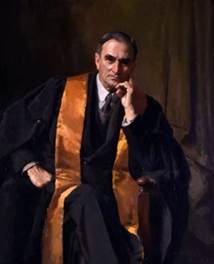
Sir Hugh Berchmans Devine (1878-1959), surgeon, was born on 13 May 1878 at Little River, Victoria, eldest son of John Devine, farmer, and his wife Mary Anne, née Gleeson, both born in Geelong. His family was Catholic and he was educated at St Patrick's College, Ballarat. After matriculation in 1894 he studied pharmacy and was employed by Henry Francis of Bourke Street, Melbourne; he was registered as a pharmacist on 10 January 1900.
In 1902 Devine began his medical studies and was resident at Queen's College, University of Melbourne. After a brilliant course he graduated in 1906, gaining the Beaney scholarship in surgery. He was resident medical officer at the (Royal) Melbourne Hospital and then acting superintendent. Influenced at this time by (Sir) Thomas Dunhill, whose brother he had known well, he joined the staff of the young St Vincent's Hospital. The high quality of work of Devine, Dunhill and their colleagues gave impetus to the hospital's growth and gained for it added status when it became affiliated with the University of Melbourne as a clinical school. Devine himself made important contributions to the development of St Vincent's both as a hospital and as a teaching school. He was for a time dean of the clinical school and eventually honorary consulting surgeon to the hospital.
On 26 July 1911 at St Patrick's Cathedral, Devine married Mary Josephine O'Donnell. Later that year he went abroad to study at the renowned Allgemeines Krankenhaus, Vienna. At this time the use of X-rays in clinical medicine was in its infancy and its development was a feature of the Viennese School. Devine was quick to realize its potential in the early accurate pre-operative diagnosis of disorders of the stomach and colon and this was a factor in directing his interest to surgery of these parts.
After further study in Britain and the United States of America Devine returned to Melbourne. In 1914 he obtained the degree of master of surgery of the University of Melbourne and quickly became involved in a rapidly growing private practice. Surgical distinction came to him soon and he was recognized by his colleagues as in the forefront of his specialty.
Devine was one of the original advocates for the formation of a surgical college and played a decisive role in the development from 1928 of the Royal Australasian College of Surgeons (originally the College of Surgeons of Australasia). He was founder, a foundation fellow, a member of council, and president in 1939-41. He was largely responsible for the newly formed college gaining from the Hogan government tenancy of the island of land in Spring Street on which its building stands. In 1928 he edited the first number of the journal of the college, the Australian and New Zealand Journal of Surgery. He continued as editor for eighteen months and then for the next twenty years chaired the editorial committee.
For ten years from 1936 Devine was first chairman of the executive committee of the Anti-Cancer Council of Victoria. He was knighted in 1936 and in 1945 was made an honorary fellow of the Royal College of Surgeons of England. Other honorary fellowships were bestowed upon him by the Association of Surgeons of Great Britain and Ireland, the Royal Society of Medicine and its proctological section, the American College of Surgeons, the International College of Surgeons and the Greek Surgical Society.
His surgical repertoire included all the routine operations of the abdomen, neck and limbs, but he was at his best when operating in the confined space of the abdomen, especially the upper abdomen. His Surgery of the Alimentary Tract (1940) is a lasting record of his pre-eminence in this field. It contains almost 700 illustrations and, drawing as it did on his own surgical experience, is rich in original thought and method. The Surgery of the Colon and Rectum, which he wrote in collaboration with his son, was published in 1948. Throughout his career he contributed regularly to surgical periodicals, yet his ability to write in a more popular vein is shown by newspaper articles such as 'Good Doctoring for the People' (1945) and 'The Tragedy and Challenge of National Health' (1951).
In 1952 Devine became chairman of a committee to administer a sum of money left by Michael ('Jack') Holt of Mordialloc to St Vincent's Hospital for purposes of research. His part in the formation of the St Vincent's School of Medical Research and his choice of its founding director, Dr Pehr Edman, may yet be considered his most lasting memorial.
Vigorous, energetic and robust, Devine enjoyed many outdoor sports, particularly tennis, golf, shooting, fishing, and sailing his ocean-going yacht. He spent at least six weeks of the year at his seaside home at Flinders, where he also prepared and wrote his books. The death in 1955 of his son John, a prominent surgeon and author of The Rats of Tobruk, was a heavy blow. Sir Hugh Devine died on 18 July 1959 and was buried in Melbourne general cemetery. He was survived by his two daughters.
In 1965 the Hugh Devine chair of surgery was established in the University of Melbourne to commemorate his services as a distinguished surgeon at St Vincent's Hospital, where the professorial unit is located. In 1972 the council of the Royal Australasian College of Surgeons approved a medal to be struck to honour and perpetuate his name, to signify the highest honour the college can bestow upon a fellow during his lifetime.
A portrait by William McInnes hangs in the College of Surgeons, Spring Street.
THE RUTH ELLIS CASE
King Charles has recently pardoned the last woman to be hanged in Britain, who was executed for the murder of her lover in 1955.
The role of Demond Cussen (40) in the case has never been fully explained.
At the time of her trial, the case against Ellis, a nightclub hostess and manager, seemed overwhelming. She shot her lover, David Blakely, outside the Magdala pub in Hampstead on the night of Easter Sunday, 1955, felling him with one bullet and pumping four more into him before an off-duty policeman removed the revolver from her hand. She offered no resistance.
At her trial, her hair freshly dyed platinum and wearing a well-cut black suit with astrakhan collar and cuffs, she seemed unnaturally cool. When the prosecuting counsel asked her: "When you fired that revolver at close range into the body of David Blakely, what did you intend to do?", she sealed her fate by responding: "It is obvious that when I shot him I intended to kill him."
Her counsel, Melford Stevenson, had wanted to argue provocation as a defence. He told the jury that she had been "driven to a frenzy which for the time being unseated her understanding". If that had succeeded, she would have been found guilty of manslaughter and spared the gallows. But the judge, Sir Cecil Havers, ruled it out. He said there was no evidence on which a jury could possibly conclude that it was a case of provocation, and left the jury no choice but to convict her of murder.
Justice worked quickly in those days. The trial in June, only two months after the shooting, lasted just over a day. The jury took less than half an hour to reach a unanimous verdict of guilty.
Ellis had two young children but, despite huge public sympathy and newspaper campaigns for a reprieve, she was hanged on July 13 1955, only 13 weeks after she shot Blakely dead and three weeks after the trial.
But there was more to the story than came out at the trial. More than 17 books and the 1985 film Dance with a Stranger ( Cussen played by Sir Ian Holm) have looked at the events leading up to Ellis's execution, but answers to some of the puzzles that remained unsolved have emerged only in the past few years. She claimed at the time to have been given the gun by an American serviceman as security for a nightclub debt, and to have taken a taxi to the pub. Much later it emerged that her friend and "sugar daddy", Desmond Cussen, an accountant with whom she had had a brief sexual liaison, had driven her to the pub and provided the gun.
Home Office documents released only in 1999 reveal that Ellis made a dramatic death-cell revelation on the morning before her execution to a prominent solicitor, Victor Mishcon. She told him that she was not the lone, cold-blooded killer she had seemed at her trial.
On the weekend she killed Blakely, she had been making frantic attempts to contact him at the home of friends. He was avoiding her and his friends denied he was there. She went round to the flat on Good Friday and made a scene, only leaving when he phoned the police.
On Easter Sunday, she told Mishcon, she had been drinking Pernod for many hours with Cussen, who had handed her the loaded gun and driven her to the scene of the murder. According to a Home Office note, Ellis told Mishcon: "I didn't say anything about it up to now because it seemed traitorous, absolutely traitorous."
Mishcon rushed to the Home Office and the permanent secretary, Sir Frank Newsam, was tannoyed at Ascot races. Scotland Yard were ordered to search for Cussen, but he was not at home and they gave up after an hour.
A prison officer who had sat in on the interview confirmed Mishcon's account but added that Ellis had said she asked Cussen for the gun, a detail that was to prove crucial to the Home Secretary's decision to let her hang. The authorities considered prosecuting Cussen, who later died in Australia, as an accessory, but decided it would be impossible without Ellis as a witness.
Two decades later, in the 70s, according to Bernard de Maid, the solicitor handling the appeal, Ellis's solicitor, John Bickford, a friend of Cussen, wrote to Scotland Yard admitting that he had concealed from the jury that "Cussen had driven her to Hampstead, provided the gun, and had goaded her into shooting Blakely to remove a love-rival from the scene."
Two days before the hanging, Ellis's lawyers had submitted evidence, including the testimony of witnesses that Blakely had inflicted repeated beatings on her and that she believed he had caused the miscarriage she suffered just 10 days before the shooting with a punch to the stomach. But it was not enough to save her, although nine out of 10 women sentenced to death in the 20th century have been reprieved and served jail terms instead.
Newsam advised the home secretary: "It would be a bad day for this country if we adopted the doctrine of crime passionelle This was a deliberately planned and cold-bloodedly executed murder."
At the time of the trial, provocation was narrowly interpreted, applying only to killers who reacted "in hot blood" to something happening immediately before the killing. In the 90s, however, judges softened the law on provocation, opening it up to battered women and others whose self-control was affected by despair or depression. Ellis, her lawyers argue with backing from a leading forensic psychiatrist, was suffering from post-miscarriage depression. As well as provocation, they claim she suffered from diminished responsibility, another partial defence that can reduce a murder charge to manslaughter. It was not a defence in 1955 but was enacted two years later, largely as a result of Ellis's case.
A key character in the story is Desmond Cussen, Ruth's ardent admirer and occasional lover, who becomes entangled in Ruth's destructive love triangle with Blakely. Desmond had an affair with Ruth and she lived with him when her relationship with David was unstable.
But what more do we know about Desmond Cussen and what became of him after Ruth Ellis' death?
Desmond Cussen was born in Epsom, Surrey, in 1923, and came from a wealthy family. He followed his brother and two cousins to Beaumont leaving in 1940 to join the Royal Air Force during World War II, training as a pilot in South Africa and primarily flying heavy bombers; He piloted Lancaster bombers until the conflict ended. After leaving the military, he entered the business world and became involved in his family's tobacco company, Cussen and Co..
Residing in London, Cussen frequented clubs and bars where he met Ruth Ellis, the manager of the Little Club in Knightsbridge. Cussen was captivated by Ellis, leading to a close and financially supportive relationship.He even offered his Devonshire Street home as a sanctuary for Ellis from David Blakely. Reports suggest that Ellis and Cussen also had a romantic relationship.
Ellis claimed that Cussen had provided her with the gun, taught her how to use it, and drove her to the pub on the night of the murder. However, Cussen denied ever giving her the weapon. He was never prosecuted or formally implicated in any crimes related to the case. Following Ellis' execution, Cussen relocated to Australia in his 60s, where he lived for several decades before passing away in 1991, reportedly battling alcoholism.
GISS - GOSS
GISS – GOSS is THE REVIEW gossip column with tittle-tattle gleaned from various sources.
His Honour Dr Judge Jeremy Connor (56)
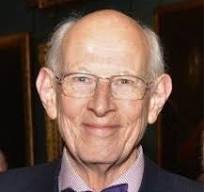
John Harding ( The Guardian-Obituary)
Mon 30 Mar 2026 16.17 BST
My friend Jeremy Connor, who has died aged 87, was a circuit judge in London from 1996 to 2004, having spent his earlier career as a barrister and then as a stipendiary magistrate.
Aside from his work directly inside courts, Jeremy was also, for many years, chair of two legal bodies – the Inner London Youth Courts, which oversees best practice in youth courts and examines sentencing data, and the Inner London and City of London Probation Committee, a statutory body in charge of probation services.
Born in Crowborough. East Sussex, Jeremy was the only child of Joseph, a builder, and Mabel (nee Adams), an artist. Educated at Beaumont school in St Albans, Hertfordshire, (ED Typical but not unexpected error !) ,he went to University College London to read law and then trained at the Middle Temple before becoming a criminal law barrister.
He worked in that role until 1979, when he was appointed as a stipendiary magistrate in London at Bow Street magistrates court, taking on the chairmanship of the Inner London Youth Courts the following year and elected as chair of the Inner London and City of London Probation Committee in 1989.
For a number of years he was also an active member of the Institute for the Study of Treatment of Delinquency (now the Centre for Crime and Justice Studies), which tries to find better ways of dealing with young offenders through focused supervision and crime prevention.
Jeremy relinquished each of those roles in 1996, when he moved on to become a circuit judge, sitting in crown and county courts in London and also serving as a member of the Parole Board of England and Wales, helping to make decisions about the release of serious offenders on parole or life licence.
In retirement from 2004, he studied for a theology PhD at King’s College London, which he received in 2011. An articulate, approachable, outgoing and highly principled man, he also enjoyed watching opera, going to the theatre and travelling and writing.
He is survived by his partner of 55 years, Peter Lantos, an expert on neurodegenerative diseases who became professor of neuropathology at the Institute of Psychiatry at King’s College London. They were joined in legal partnership in 2006.
Peter is a remarkable man:-
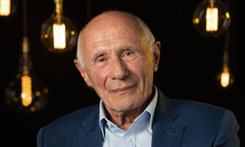
Peter Lantos BEM
By the age of 30, Peter Lantos had endured the horrors of Bergen-Belsen concentration camp, lost most of his family, suffered abuse at the hands of Hungary’s Communist police, earned a medical degree and defected to England.
“Antisemitism, the hatred of Jews which fuelled the Holocaust, is alive and well everywhere, including this country. This is the reason why I decided to tell my story to younger generations”.
Peter Lantos was born on 22 October 1939 in Makó, a small provincial town in south eastern Hungary. His maternal family owned a timber yard managed by two of his uncles who lived in adjoining villas on the property. In contrast, Peter’s immediate family resided in a modest annex at the back.
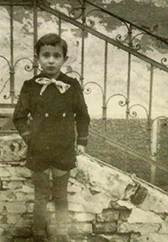
Peter as a young child
In 1944, following the German occupation of Hungary, a wave of antisemitic laws was enacted. Peter’s 18-year-old brother was taken away for forced labour and never returned. Shortly afterwards, the family was forced into the ghetto in Makó where they remained for several weeks. In the summer of 1944, at the age of five, Peter was deported to Bergen-Belsen in northern Germany with his parents – simply because they were Jewish. His happy childhood was abruptly shattered – he lost his toys, his home and his friends.
The safe, familiar world he knew vanished, replaced by uncertainty, despair, disease, hunger, cruelty and starvation – and, ultimately, by the death of those around him.
Upon arrival, Peter became prisoner number 8431. He and his mother were separated from his father, and, with each passing day, life grew more unbearable. Bread rations dwindled, standing for roll call in the icy wind became increasingly torturous and disease spread rapidly through the camp. There was no place for children to play or form friendships; instead, they were forced to witness constant cruelty and death. Though Bergen-Belsen was not an extermination camp – there were no gas chambers – it became a ‘hell on earth’ through starvation, disease and relentless suffering.
Severe overcrowding, starvation and lice created ideal conditions for the spread of disease. Typhus, typhoid fever dysentery and tuberculosis were rampant and uncontrolled. Peter’s father died of starvation just four weeks before the British Army liberated Bergen-Belsen on 15 April 1945. After surviving the camp, Peter and his mother returned to Hungary but it was far from a joyful homecoming.
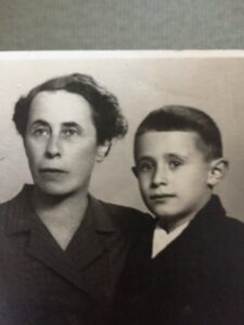
Peter with his mother Ilona soon after their return from Bergen-Belsen
They learned that 21 members of their family had been murdered. His brother had died of typhoid fever only a month before their return. Witnessing such immense suffering as a child was a decisive factor in Peter’s decision to become a doctor. Initially, his plans to study medicine were blocked by the Communist authorities who labelled him ‘alien class’. However, his mother successfully challenged the classification, and he was eventually allowed to pursue his studies. After qualifying, he was fortunate to receive a research fellowship in 1968, which enabled him to work in London.
As the one-year research fellowship neared its end, Peter made the decision not to return to Hungary, driven by political, professional and personal reasons. In response, the Hungarian authorities sentenced him in absentia to 16 months in prison and ordered the total confiscation of his possessions. He would not set foot in his homeland again until after the fall of Communism in 1989.
Peter’s career in academic medicine in England spanned more than three decades, during which time he made significant contributions to the understanding of neurodegenerative diseases, including Alzheimer’s and Parkinson’s. His work gained international recognition, and he was elected a Fellow of the Academy of Medical Sciences.
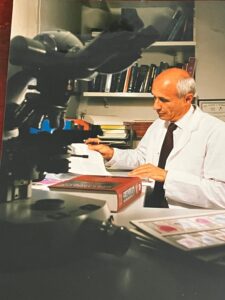
Peter’s career in academic medicine
Peter only fully grasped the significance of his Holocaust experiences during his teenage years. Despite this, he chose not to carry the psychological burden of these memories and believes he has succeeded in doing so. He decided to learn German at school and, as soon as he had the chance, travelled to East Germany as a medical student. There, he made German friends, which helped him overcome feelings of hatred. He described this openness as an effort to understand what happened and how it could have happened.
BOOKS
us to write Parallel Lines: a Journey from Childhood to Belsen, published in 2006 by Arcadia Books London, reprinted in 2007 and translated into Hungarian, German and Italian. The book has attracted unanimously favourable reviews, and Alan Sillitoe described it as “something of a genius with the readability of a classic.” It has been reprinted again with a new cover and a Foreword by Lisa Appignanesi in February 2014. It featured both on BBC radio and television and has been reprinted five times and again by Quercus in 2023.
His first novel, Closed Horizon, is a vision of the near future in the Republic of Great Britain, where conflicts between individuals and the Surveillance State create complex moral dilemmas. It is a story of loyalty and betrayal, guilt and forgiveness, blackmail and courage. In the words of Baroness Helena Kennedy QC: “A brilliant and terrifying novel about the fragility of freedom” .
Peter has written six plays, published in two books: Stolen Lives (2018) and Love and Obsession (2021)
His most important work: The Boy who didn’t want to die. Is for children so that the horrors of the Holocaust are not forgotten
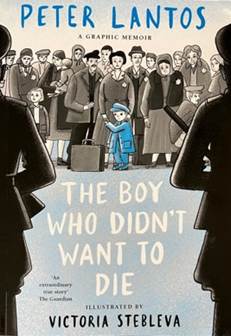
Peter, a boy of five, makes an extraordinary
journey through war-torn Europe, travelling with his parents from a small
Hungarian town, through Austria and on to Germany.
Along the way, unforgettable images of adventure
flash one after another: sleeping in a tent and then under the night sky,
discovering a disused brick factory, catching butterflies in the meadows,
before Peter realizes that the adventure
is really a nightmare, as he watches bombs fall from the blue sky outside
Vienna and starts lessons with his mother in Bergen-Belsen.
Drawn against a background of terror,
starvation, and his father’s and grandmother’s deaths, this is a story of
survival; of love between mother and son; and of enduring hope in the face of
unspeakable hardship.
This new illustrated
edition, also published by Scholastic in 2025, brings Peter’s story to a new
audience, with phenomenal illustrations from Victoria Stebleva.
It featured on BBC One Breakfast show on 7th January 2025 – the day the book
was launched.
Christopher Gardner-Thorpe ( some memories)
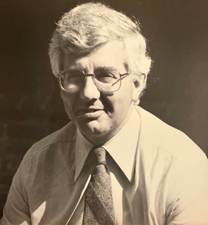
By Emma Laws, Exeter Cathedral Librarian
It’s no secret that Exeter Cathedral Library holds one of the country’s largest historic medical collections. At its core is the private library of about 350 works of science and medicine bequeathed to the Cathedral Library by the Exeter physician and bibliophile, Thomas Glass, on his death in 1786. The connection between the city’s cathedral and hospital is also no secret: the Dean of Exeter Cathedral, Alured Clarke, founded the Devon and Exeter Hospital (now the RD&E) in 1741 – and Thomas Glass was one of the hospital’s six founding physicians.
Thomas Glass stipulated in his will that his books should be available to ‘any physician being an inhabitant of the city’. His bequest thus extended the purpose of the Cathedral Library as a centre of learning and inspiration for secular readers as well as clerics, and his generosity and foresight created a legacy of aspiration and participation that continues today. We are proud of the fact that Exeter University’s medical students still come to the Cathedral Library to consult Thomas Glass’ books as part of a Fourth Year Medical Humanities module, ‘What Can History Tell Us?’
Collections beget collections. In 1964, the Cathedral Library acquired another important collection of science and medicine on permanent loan from the Exeter Medical Trust. The most recent legacy collection of the bequest of Thomas Glass is the Christopher Gardner-Thorpe Collection. We are delighted to announce that Dr Christopher Gardner-Thorpe MD FRCP FRCPE FACP, retired Consultant Neurologist at the RD&E, has generously donated a collection of historic medical books to sit alongside the Thomas Glass Bequest. (Some of you may have attended Dr Gardner-Thorpe’s Presidential Address to the Devon and Exeter Medical Society, delivered in the Chapter House in October 1999. His resulting publication, ‘Stones unturned: memorials of medical significance in Exeter Cathedral’, was printed the following year.) Dr Gardner-Thorpe has long had a keen interest in the work of James Parkinson (1755-1824) and amassed a collection of Parkinson’s works, including an extremely rare copy of his ground-breaking 1817 essay on the shaking palsy, the neurodegenerative disorder that would become known as Parkinson’s Disease.
Dr Gardner-Thorpe’s generous donation also includes Parkinson’s work in geology and palaeontology, including early editions of his Organic remains of a former world (1804-1811) and Outlines of oryctology (1822). Alongside the publications of Parkinson are those of a number of his associates: Gideon Mantell, an English obstetrician and geologist, who praised Parkinson’s Organic remains of a former world as ‘the first attempt to give a familiar and scientific account of fossils’, and Jean-Martin Charcot, a French neurologist, who coined the term ‘Parkinson’s Disease’ after James Parkinson.
The collection of Dr Gardner-Thorpe is now publicly available at the Cathedral Library. At a time when students receive course material through a virtual learning environment, it seems even more important to have access to the material history of science and medicine – and to appreciate the many shoulders of medical knowledge and experience on which we rest.
Tony Waldeck (57) writes:
Christopher and I were early post war (1947) pupils at St Phillips in Kensington. Afterwards we continued to Beaumont. I saw much of him, especially after moving to Cornwall in 2013.
Christopher was struck down with (ironically) a neurological condition which left him paralysed from the waist down. He spent the last 3 years of his life, bedridden at The Lodge care home in Exeter. I tried to visit him at least once a month. Despite his condition he remained in good humour and was really entertaining company. I commented to him that this robust demeanour was quite remarkable - his reply to which was "there would be no point in dealing with it in any other way". Not surprisingly his death, although timely, had quite an effect on me. A Great Man.
Christopher had 5 children. 2 daughters and 3 sons. The boys all became medics; 2 are GPs and one a surgeon in Sheffield majoring in cancer work. The girls had careers outside medicine (I think). Anne, lives in Exeter, worked in accountancy and is rather handling post mortem affairs.
Some will remember Christopher’s Father Sir Ronald – a man that lived life to the full.
Ronald Gardner-Thorpe was born in Portsmouth and followed his family tradition in the property and building industry. He became a Friend of the Royal College of Physicians assisted in raising funds - in particular for the St Andrews Precinct - and was proud of the honorary fellowship bestowed upon him by the College in 1986.
He spent his early years in Southsea and attended St John’s College, a Catholic school run by the de la Salle brothers. He enjoyed his school days and made many lasting friendships. He was a keen sportsman and particularly enjoyed cricket; at one time he played for Hampshire County. While encouraged to spend his first few working years m the family building business, mainly in Portsmouth, his work also took him as far afield as Barrow in Furness. He joined the Territorial Army in 1937 and was soon commissioned in the Hampshire Heavy Regiment. In 1938 he married Hazel, née Dee; they celebrated the 53rd anniversary of their wedding in 1991.
During the early war years, he was responsible for capturing probably the first foreign spy detained on British soil – a young lady sketching shipping in The Channel.. The war years found him undertaking liaison duties in Ottawa and Washington to assist communication between American and British Forces and his ability to entertain involved him in stage appearances with Shirley Temple, Rita Hayworth and Deanna Durbin. His activities helped to raise money for the war effort in Britain. Later, he was appointed Barker of the Variety Club of Great Britain and helped provide Sunshine Coaches for children. He was vice-president of the Miss World organization in 1982 and while Lord Mayor had given a breakfast for the winner -Gabriella Brum: she resigned shortly afterwards when compromising photos of her appeared in magasines.
Military duties occupied him in the regular Army until 1947 and then he moved to London to continue property work. He remained in the Territorial Army, ultimately commanding the 5th Battalion of the Buffs, 1956-60, when he was promoted colonel. During a parade he commanded in Canterbury in 1960 he was installed as knight commander of the Royal Order of Dannebrog by King Frederik. He was awarded the Territorial Decoration in 1948 and subsequently three Bars.
In later years he became a member of the court of the Honourable Artillery Company. Civic duties gradually encroached upon his family property business. He was appointed JP in the inner London area in 1964 and for the City of London in 1969. The freedom of the City of London was conferred upon him in 1971, he was elected Alderman in 1973, Sheriff in 1978 and Lord Mayor in 1980 when he was created GBE. His work as Lord Mayor took him to Saudi Arabia, Rome and America, as well as to many other places. During his mayoral year he had happy memories of bearing the pearl sword of the City of London when he preceded HM The Queen up the nave of St Paul’s Cathedral at the time of the wedding of the Prince of Wales and Lady Diana Spencer.
His connections with the City of London enabled him to draw the attention of a wide range of organizations in the City to the activities of the College. Ronald Gardner-Thorpe’s interest in medicine is continued in his family; his son Christopher is a neurologist, his eldest grand-daughter is a doctor in hospital medicine and his two grandsons are continuing their clinical duties at Cardiff and Bristol.
From Ashley Daly (65)
I knew Christopher Gardner Thorpe although he was not of my generation at Beaumont. My Father was the Senior Physician at the RD&E when he arrived there and was therefore part the final intake of young Consultants to be taken on during the final few years of my father’s tenure. He knew my Father well and he was very helpful to my family when my father died.
My father came to Exeter in 1947. He was one of, I think, 9 consultants-who oversaw the transition to the NHS. Being the prominent hospital serving Devon and Cornwall, he and his colleagues had the task of transitioning to the NHS and then later, rebuilding the hospital-which had to be done twice as the first one had to be demolished as a result of concrete cancer. Christopher came in on the end of this, but was one of a line of distinguished Doctors to come to Exeter. He was, of course, as well as many other things, involved in the establishment of the Peninsular Medical School.
My parents eventually moved to Suffolk in their final years to be nearer to my sister, as she had retired and was able to look after them. My father died in Suffolk and it was thought that, in the light of the time my parents had been in Devon there should be a Memorial Gathering of the many patients and colleagues who had known him (and my mother). Christopher and a retired surgeon called Andrew Knox (Master of the Silverton Foxhounds and also had a few useful point-to-pointers) was instrumental in organising this. It was appropriately held at the Peninsular Medical School. At the end of the proceedings, a portrait of my father was presented to the Devon and Exeter Medical Society on the condition that it should be hung in an appropriate place in the hospital. A few years later, Christopher contacted me to say that it had been stashed away (together with a number of other portraits and various pictures owned by the hospital-some of which were by eminent 18th & 19th C artists and therefore quite valuable). Christopher and I together with another retired consultant therefore crept into the admin offices when no one was there one winter’s afternoon and rifled through a filing cabinet which had already been identified, found the portrait, and somehow secreted it away. My brother now has it displayed on a wall in his London flat.
Interestingly, the Senior Executive (obviously not a doctor, and having no sense of history) had decreed that all old decorations and especially portraits should be taken down as he did not want employees living in the past! The word Philistine comes to mind!
I obviously don’t know your source or how old it is but if the news is sufficiently recent, I would like to go to the funeral-wearing my BU tie, of course. I have put out feelers but not had anything back, yet so if you can let me know anything I would be grateful.
On another note, although, he was not an OB, you may remember taking my brother-in-law to play golf for the BU. ( Ed he stood in to help one of our memorable victories over the Old Gregorians). Sadly, he died rather suddenly in October. We gave him a good send-off in the Snape Maltings. I was asked to say a few words on behalf of the family, squashed between a General (Roddy Cordy-Simpson) and a Director (rtd) of Shell. Beaumont somehow gets in somewhere!
Sorry to ramble on-must be the weather-I trust you had a good day at Beaumont and was sorry not to be there but look forward to reading about it in the next News Letter.
PAST Memory – the Centenary CELEBRATION 9/10 October 1961.
9th October 1861 was the actual date the school opened - a little late in the autumn but it seems that the boys failed to turn up in September. There were various celebrations a hundred years on including the Solemn Requiem at Farm Street ( perhaps they should have had that in 1965 as well!). This was followed by a Reception for OBs and the School at The Criterion. The next evening the BVU held their Dinner at Beaumont and the whole School was again invited.
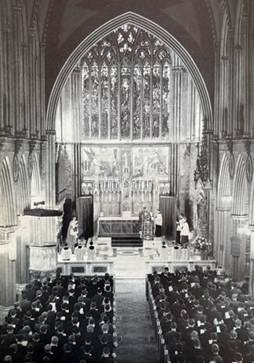
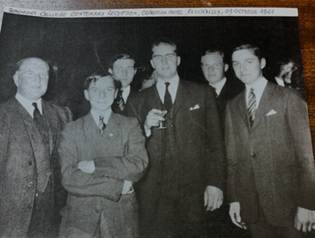
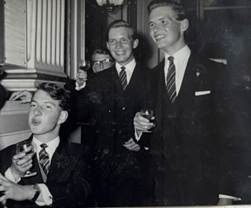
At the Criterion: de Lisle Family.
At the BU Dinner: Wilkinson Brothers,
With Michael Tussaud & Roger Darby
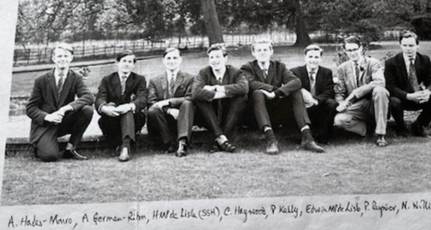
Mixed years ( or bunch) beside the pond on the Captains’ lawn.
ORIGINAL OBs 1876 (150 years ago)
Some of the original 65 members who formed the Union.
Barff Frederick : London Barrister, son of distinguished Chemist.
Beauclerk Henry: SJ Vicar General.
Beauclerk Robert: Prof. of English & Latin Cairo University.
Berkeley Maurice: Major Worcestershire Regiment , JP & DL for Worcestershire.
Berkeley Robert: MFH Berkeley Hounds, JP & DL, High Sheriff 1909 of
Worcestershire.
Berkeley Thomas: Colonel Black Watch, King’s Gentleman Bodyguard, WW1 KIA
1916.
Blundell Francis: Of the recusant Catholic Crosby family.
Bowden Launcelot: of another recusant family, J P, m .Baroness Grey of Ruthin.
Their descendants carry that title.
Cahill John: London Surgeon. Adviser to the Egyptian Civil Service and a Member
of the Medical Commissioners’ Board.
Cann Daniel: Solicitor Cann & Son, Gray’s Inn.
Cann Edwin: Stockbroker.
Cann John: Solicitor as above with Daniel.
Clifford Charles: Son of Sir Charles Bt, Father of Sir Lewis SJ.
Callaghan William; Killed falling from his horse 1890.
Collins Henry: Barrister
Coltsmann Daniel: JP and DL Co. Cork
Day Joseph: Engineer, inventor two stroke motor.
Day Samuel: Middle Temple, Barrister. Master of Supreme Court of Judicature
De Freyne Lord: Irish landowner, Hon Colonel Connaught Rangers.
Fitzherbert Hon Basil: bother of Lord Stafford, WW1. Capt. RFC.
French Hon William: Didn’t succeed his father because of Marriage law, Rancher
and Sheriff in New Mexico USA.
Galton Hubert: Major RA. Sec Catholic Soldiers Assoc. m. Emily D. of Gen. Sir
Henry Clifford VC.
Galton Howard: Barrister, brother of above and of Bishop Galton.
Gordon- Canning William: MFH and landowner. Fr of Robert - Fascist and
Mosley’s Best Man.
Heathcote Gilbert: Soldier and 8th Baronet.
Howell David: JP, KSG and Privy Chamberlain to Pope benedict XV.
Knill John: 2nd Baronet City Alderman, Sheriff Lord Mayor London 1909-10, KCSG
President of SVP.
Lavalle Herman: He had escaped France during the Franco-Prussian War and was
the first French Member of the BU
MacNamara William: Irish landowner, KCSG.
Maxwell Hon John; Son of Lord Herries through whose family Beaumont, the
Jesuits funded the purchase of Beaumont.
Mivart Frederic: Eminent Physician studied in Vienna and Paris. His even more
Famous father was excommunicated from the Church for his
writings.
Monsell Hon Gaston. Later 2nd Lord Emily, Irish Nationalist protagonist.
Monteith Joseph: Scottish landowner
Munster John; Called to the Bar but practised as a solicitor with the ‘Beaumont’
firm of Roskell, Munster, Witham &Weld in the City.
Munster William: MP for Mallow.
Norris Richard: Colonel, DSO seeing service mainly in W Africa and commanded
the punitive Karene Expedition in 1898.
Oddie Arthur: Chairman Sussex CC.
Parker Henry: Son of Australian Governor Sir Henry Parker . Solicitor and
Government appointments in Perth.
Pedley Charles: Father a onetime bookmaker and Derby winner, Tea planter in
India.
Plowden William: Of Plowden Hall, JP and DL for Salop.
Roskell Charles: First Beaumont Boy. Solicitor with John Munster.
Scott-Murray Basil: Gs of Lord Lovat, Father was an MP. He was a career officer in
the Scots Guards.
Strong- Hussey Henry: Played Cricket for Ireland. Landowner.
Vavasour Edward: A grandson of both Lord Clifford of Chudleigh and Lord
Mowbray. Died in Antigua of yellow fever.
Wilberforce Basil: Gs of the abolitionist and MP William. Inherited Markington Hall
the family residence in Yorkshire.
1926 JUBILEE (100 years ago)
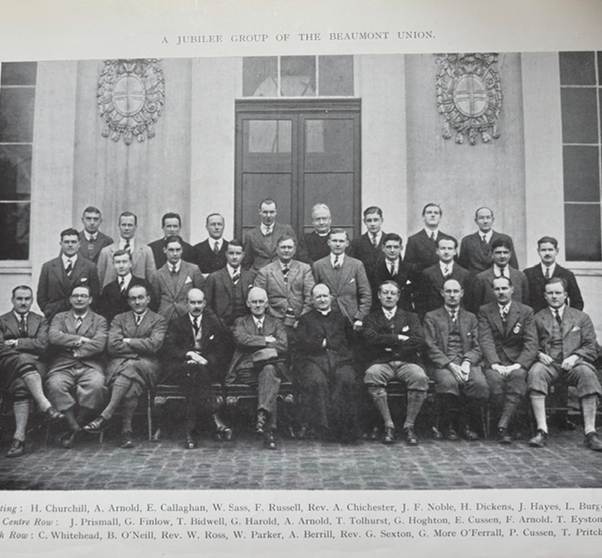
Ed: not certain what they had turned up for that required ‘plus fours / twos.’
The BU held their Dinner at Beaumont Chaired by Ld. Russell of Killowen which include a message of Congratulations sent from Pope Pius X1.
They also celebrated with a Dance at The Princes’ Galleries on Piccadilly. 270 attended and the dancing commenced with the band playing “The Carmen Foxtrot”.
This was played by the New Princes Toronto Band: Formed around 1924, this Canadian jazz and dance ensemble took on the name of the restaurant. Led by Hal Swain, and later Dave Caplan, they were famous in London's roaring twenties.
Apparently the Carmen or Beaumont Foxtrot was a standard at BU dances up until WW2.
Each Lady received a gift chosen by the Hair Dressing department of Marshall & Snelgrove ( on Oxford St. but became the ‘Flagship’ of Debenhams in 1972). Dancing continued till 3am and was followed by breakfast : the party ended at ….
The Menu did justice to the Event:-
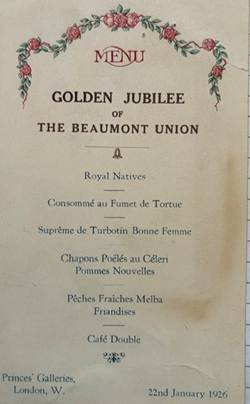
The Princes’ Galleries are long gone but at this époque it vied with the Trocadero, the Café de Paris Café Royale and the Criterion as the centre of social dining, dancing and cabaret.
The Dancing Times (Ed. Philip Richardson OB) observed that ‘it was quite Parisian to see the big open space in the centre of the room in which graceful couples floated in a mazy valse or danced the languid tango.’
All that remains today is The Princes’ Gallery Arcade joining Piccadilly with Jermyn St.
OB ACHIEVMENTS in 1926
Brigadier General Cyril Murphy DSO, MC. (98) was married. In 1917 he commanded the 2nd Corps Wing RFC of 5 Fighter Squadrons and retired in 1922.
Trevor Peppercorn (23) was the ‘spare man’ for the Oxford University VIII for the Boat Race. (He missed his Blue in ’27 with an injured wrist)
Raymond Dudley-Clarke (25) was rowing in the Cambridge Trial VIII. ( didn’t make it)
Peter Drummond (25) was in the University College Oxford Boat that was ‘Head’ of the River.
Edwin Sass and George Coleman (23) have taken their first vows as Jesuit Scholastics.
Major Ian Bruce (06) received The Papal Blessing on his marriage by telegram.
The actor / Comedian Sonny Hale (20) is engaged to actress / Film star Evelyn Laye
Lt- Colonel Edward Strutt (91) was presented with the Belgian Alpine Medal by Prince Leopold . (Strutt was ‘Climb Leader on the unsuccessful 19222 Everest Expedition)
The Duke of Alba (95) received the Order of the Golden Fleece for services to Spanish culture from King Alfonso.
Alba’s brother the Duke of Peneranda (99) Captained the Anglo Spanish polo Team that won the Ranelagh Open. (Silver Medallist in the 1920 Olympics, Murdered in the Civil War)
Jack Nelson (09) is again Captain of the highly successful Argentinian Polo Team ( Gold medallist in both 1924 and 1936 Olympics).
Francis Urquhart MA, (86) Dean of Baliol has had his portrait painted to hang in the College.
The Hon Mr Justice Russell (84) has been elected to the Committee of Surrey Cricket Club.
Thomas Woodlock (83)in the USA has been appointed to the Inland Commerce Commission (ICC) by President Coolidge. The Commission was the regulatory body for railroads and other forms of communication including telephones. ( Thomas was the Editor of The Wall Street Journal).
Service Notes
Captain Robin Dalglish RN (93) assistant to the Second Sea Lord ( Robin was later Rear Admiral and commanded the Australia Squadron)
Captain Richard Plowden DSO RN ( 93) has relinquished command of the 6th Destroyer Flotilla . (Richard retired as a Rear Admiral 1933) .
Captain Gerald Dickens CMG RN (93). To the Imperial Defence College ( Later Vice Admiral Sir Gerald KCVO, CB. Flag Officer Netherlands).
Captain Malcolm Maxwell-Scott DSO, RN (88) HMS Victory for Senior Officers Technical Course.(later Rear Admiral commander Singapore Naval base)
Colonel -Commandant Cuthbert Fuller CMG, DSO (92) commanding the Canal Brigade Egypt Has been appointed a CB by The King. ( later Major General Eastern Command).
Death
Captain Fr. Edward Mayo SJ
Fr Mayo spent most of his life teaching at Beaumont. The son of Arthur Mayo VC who as a Naval Midshipman aged 17 led a charge against an enemy gun position during the Indian Mutiny in 1857. Arthur became an Anglican Deacon but then converted to Catholicism. Fr Mayo was instrumental in starting the Corps and became its Commanding Officer.
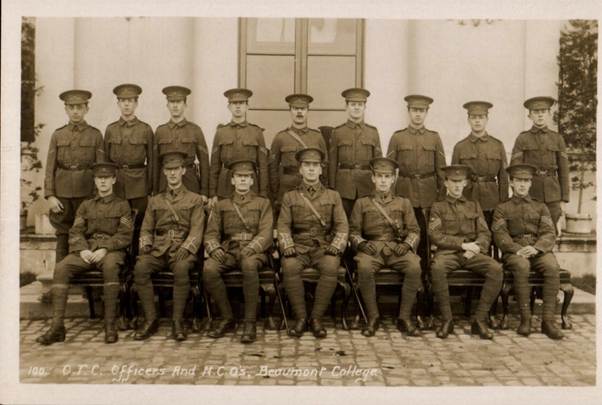
Captain Mayo with the Corps Officers and NCOs 1914
On an inspection by a visiting General the boys were asked for his whereabouts – they replied Fr Mayo is at the Mess Tent. The General replied “He is NOT Fr Mayo but Captain Mayo”. He was always addressed as Captain from then on whether in Class or on the Sports field.
Denied from being a Chaplain by the Provincial, no Officer could have prepared better his ‘Cadets’ both spiritually and mentally for the appalling rigours of The Great War. He is One of Beaumont’s true Heroes.
REMEMBERING LEO BURGESS
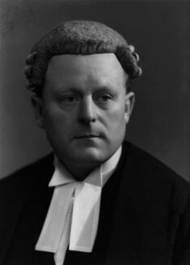
Leo (21) Captain of The School, Rugby XV, Cricket XI to Trinity Cambridge for Law, Barrister, Called from Middle Temple. Clerk of the Peace for the County of London.
Hon Se of the BU for over 30 years. Died just over 50 years ago in 1975.
GREAT WAR ( Catholics at War)
Oliver Hawkins gave me the booklet below written at the end of 1916. Although it mainly concentrates on the service of the Chaplains during the on-going conflict, there are a few pages on the contribution of the Catholic schools. – I attach the relevant page of the contribution so far made.-
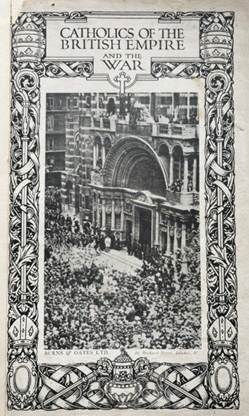
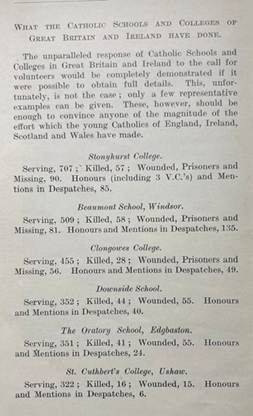
This should not be seen in anyway as a competition but naturally one notes the number of OBs serving in comparison with Downside and The Oratory of similar size. What I find extraordinary is the number of Honours awarded to OBs in comparison to other schools. Stonyhurst would eventually be awarded Three VCs ( of its seven) and Clongowes one (of its four) but there is no doubt that OB’s courage was recognised and perhaps it is not surprising that our percentage of casualties was higher than any other school in the Country.
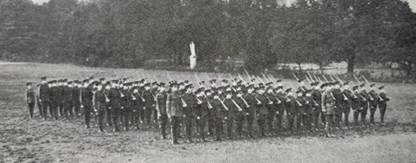
Photo taken of the Beaumont Corps in 1915
Colonel David Sherlock
I came across this memorial to a gallant OB.
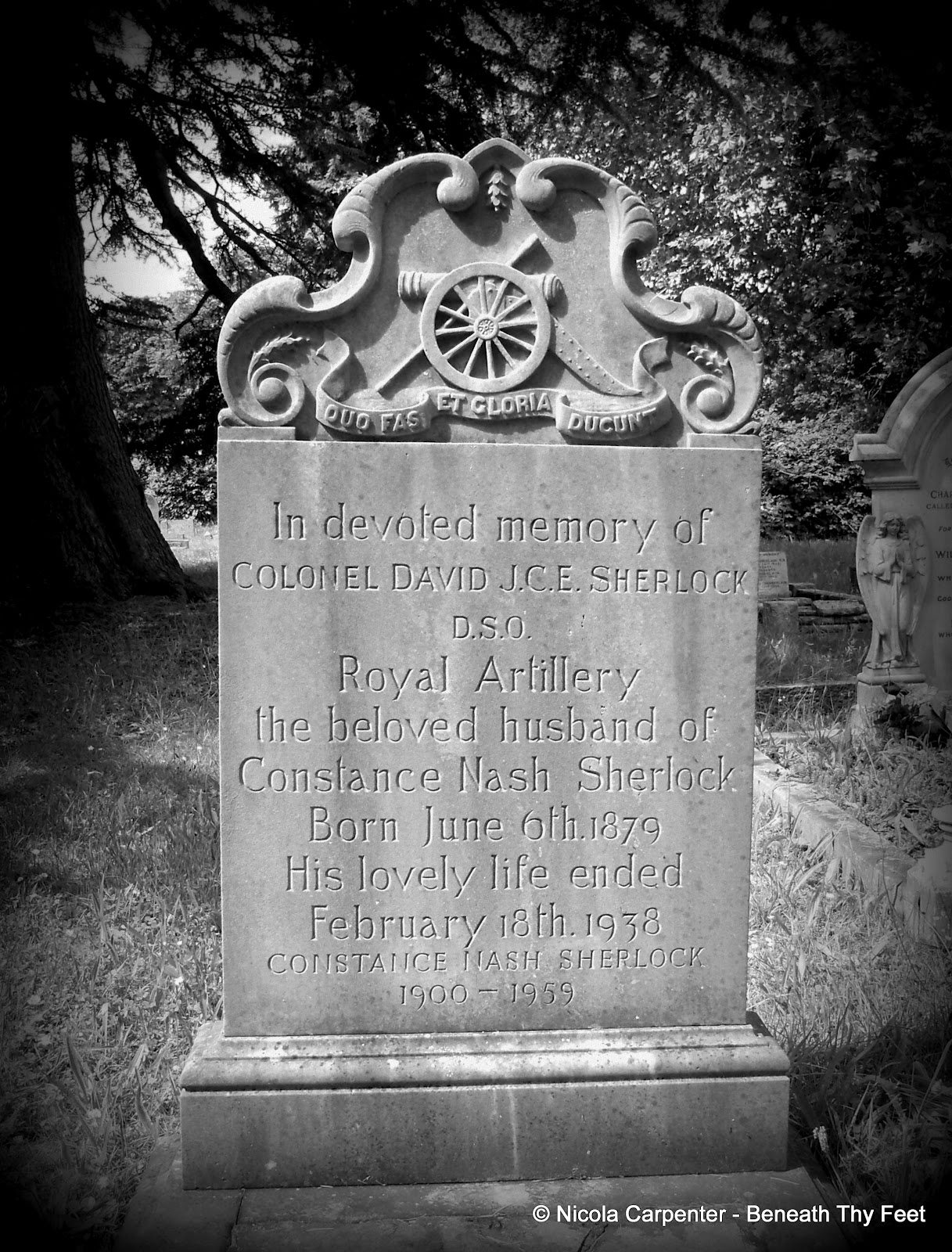
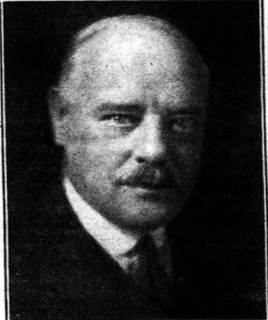
Photo by Nicole Carpenter
Colonel David J. C. E. Sherlock (OB 95)
(Taphophilia
is a passion for and enjoyment of cemeteries. The singular term is a
taphophile.)
Monument to Colonel David John Christopher Eustace Sherlock, All Saints
Maidenhead Cemetery, Maidenhead, Berkshire.
"In devoted memory of Colonel David J. C. E. Sherlock D.S.O
(distinguished service order) Royal Artillery the beloved husband of
Constance Nash Sherlock Born June 6th 1879 His lovely life
ended February 18th 1938 Constance Nash Sherlock 1900 - 1959."
David John Christopher Eustace Sherlock was born 6th June 1879 in Dublin
Ireland to David Joseph Sherlock and Mary Zeena Elizabeth Murphy. In 1900
David joined the army, serving in the Great War, first with the Royal
Horse Artillery and then later with the Royal Field Artillery. In 1930
David married Constance Nash.
The Catholic Herald printed a small notice of death for David on 28th February
1938: -
"Gallant service during the European War, in which campaign he was wounded and was six times mentioned in despatches. brought high honour, both from Britain and from France to Colonel David John Christopher Eustace Sherlock, who died on the 18th inst. at his home at Burnham, Buckinghamshire. The Royal Honours List awarded him the D.S.O., while France made him a Chevalier of the Legion of Honour and gave him also the Croix de Guerre.
Colonel Sherlock was in his fifty-ninth year. The son of Mr. David Sherlock, D.L., of Tullamore, he was educated first of all in Ireland, at Clongowes Wood College, and afterwards at Beaumont. He joined the Army in 1900. In the Great War he served with the R.H.A. and the R.F.A. He retired about eight years ago."
The Monument is at All Saints Maidenhead Cemetery, Maidenhead, Berkshire. There is a notice in the Cemetery asking visitors not only to keep it tidy ,but that “Fishing is prohibited”.
Sadly, for such a well decorated man I can find very little information on his life or that of his wife Constance.
|
|
Country Life Again!
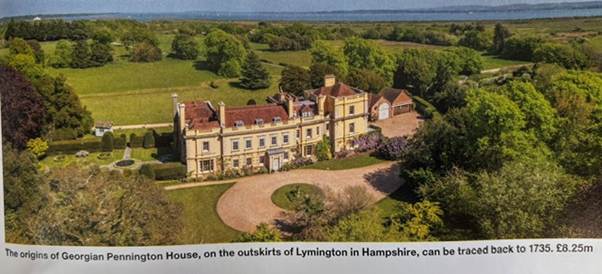
I noticed that written up in the Property pages was Pennington near Lymington. This was the home of the Gilberts between 1830 and 1916.
It is of particular interest to both myself and Tony Outred as both our Gilbert grandmothers were brought up there.
It was also where their younger brother George eloped to Canada with one of the parlour maids; their son Toby Gilbert (24) became my grandmother’s ward and was sent to Beaumont with Tony’s Pa – Frank and his two brothers Tommy and Charles. Also related to Beaumont was that my Grandmother’s two step grandsons Basil and Cyril Measures (18) spent WW1 there. Added to the list are our cousin James Outred, Tony’s brother’s Simon and Charles and my three brothers, Mike, Chris and Richard.
I suggested to Tony that the description of the state of the house could be applied to ourselves!
An Infatuation with Red TELEPONE BOXES.

As they say at the end of the article ‘ Gilbert Scott’s Kiosks are emblems of Britain and are recognisable the world over .. they say so much about who we are as a country’.
DYPTIQUE
It must be a compliment that your design is taken over by the mass media as a greetings card. Such is the case with one of the company’s founders Desmond Knox -Leet (40) whose cryptic design is used on all their products - perfumes, scents and candles. ( he was an operative at Bletchley Park). This ‘take off’ has written “Champagne, Caviar and the incomparable smell of burning money” - FREE ADVERTISING!
THE COWBOY BARONET
Whisky Dick Bedingfeld (80)
From the National Trust Bulletin
“In her enjoyable and thought-provoking piece in the last ABC Bulletin (‘Found in a tea chest at Knole’), Felicity Stimpson asked, ‘How many National Trust properties can claim such a connection with the Wild West?’ As it happens, Oxburgh Hall in Norfolk can.
In the 1880s, the young Henry Bedingfeld (heir to Oxburgh and later 8th Baronet) and his brothers were each given £1,000 and challenged to make their fortune in the United States. The US government granted them land for free near Cheyenne in Wyoming, on condition that they fenced it in: the fence round their ranch eventually extended to twelve miles.
For several years the Bedingfeld brothers lived the outdoor life. However, the saloons of Cheyenne held more attraction than ranching for Henry’s brother Richard, who was nicknamed ‘Whisky Dick’.
While Richard (80) and Charles (82) were away getting drunk, Henry was left to fend for himself, but his education had little prepared him for the simplest practical tasks such as cooking rice. Henry’s Wild West adventure came to an end in 1899, when he returned home to serve in the Boer War. He later married the sister of Stephen Lyn-Stephens (OB).
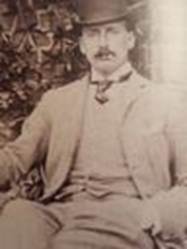
Richard died in 1931
and Charles in California in 1936.
Acknowledgements: Mrs Frances Greathead, David Just Oliver Garnett, Property Publisher, National Trust
From THE INDEPENDENT 19 June 2026. Missing Tudor tapestry sold a century ago returns to historic home after The artwork depicts Queen Esther, who features in the Old Testament Book of Esther, and once adorned the walls of The King’s Room at Oxburgh Hall in Norfolk (Andreas Von Einsiedel/ National Trust) chance discovery. A Tudor tapestry depicting Queen Esther has been returned to its historic home at Oxburgh Hall in Norfolk, nearly a century after its sale. The artwork was one of seven tapestries sold in 1924 by the Bedingfeld family to an art dealer to help fund the estate's upkeep and pay death duties. This was partially because of the death of Henry the eldest son who died at St Johns of pneumonia in 1917. The location of the tapestry was unknown until a National Trust curator spotted it for sale at an art fair in Maastricht, Netherlands, last year. The tapestry was then purchased and returned to Oxburgh Hall thanks to grant funding from multiple bodies and a private donation. In exceptional condition, the tapestry will be on public display at Oxburgh Hall from June 20 until December this year, while the whereabouts of the other six remain unknown.
Another Bedingfield find:-
A 121-year-old chocolate bar still in its original wrapper and tin has been discovered in a helmet case in the attic of Oxburgh Hall, family seat of the Bedingfield baronets. The chocolate and helmet belonged to Sir Henry Edward Paston-Bedingfield, 8th Baronet, who was a major in the King’s Liverpool Regiment and fought in the Second Boer War. He was still in South Africa in 1902 when his father died. He returned to Oxburgh to claim his ancestral home and title. The chocolate went with him.
These chocolate bars were a New Year’s present from Queen Victoria to British troops in South Africa ringing in the turn of the century. More than 100,000 half-pound tins of chocolate bearing her embossed profile and New Year’s wishes in her own handwriting were produced by Britain’s top three chocolate companies, Fry, Cadbury and Rowntree. It was an awkward commission because all three companies were founded and run by devout Quakers who specifically sought out an “innocent trade” that would allow them to make a good living without having to compromise their pacifist principles. Victoria wouldn’t let them decline to profit from selling chocolates for troops fighting in an active war zone, so all three companies were strong-armed into it.
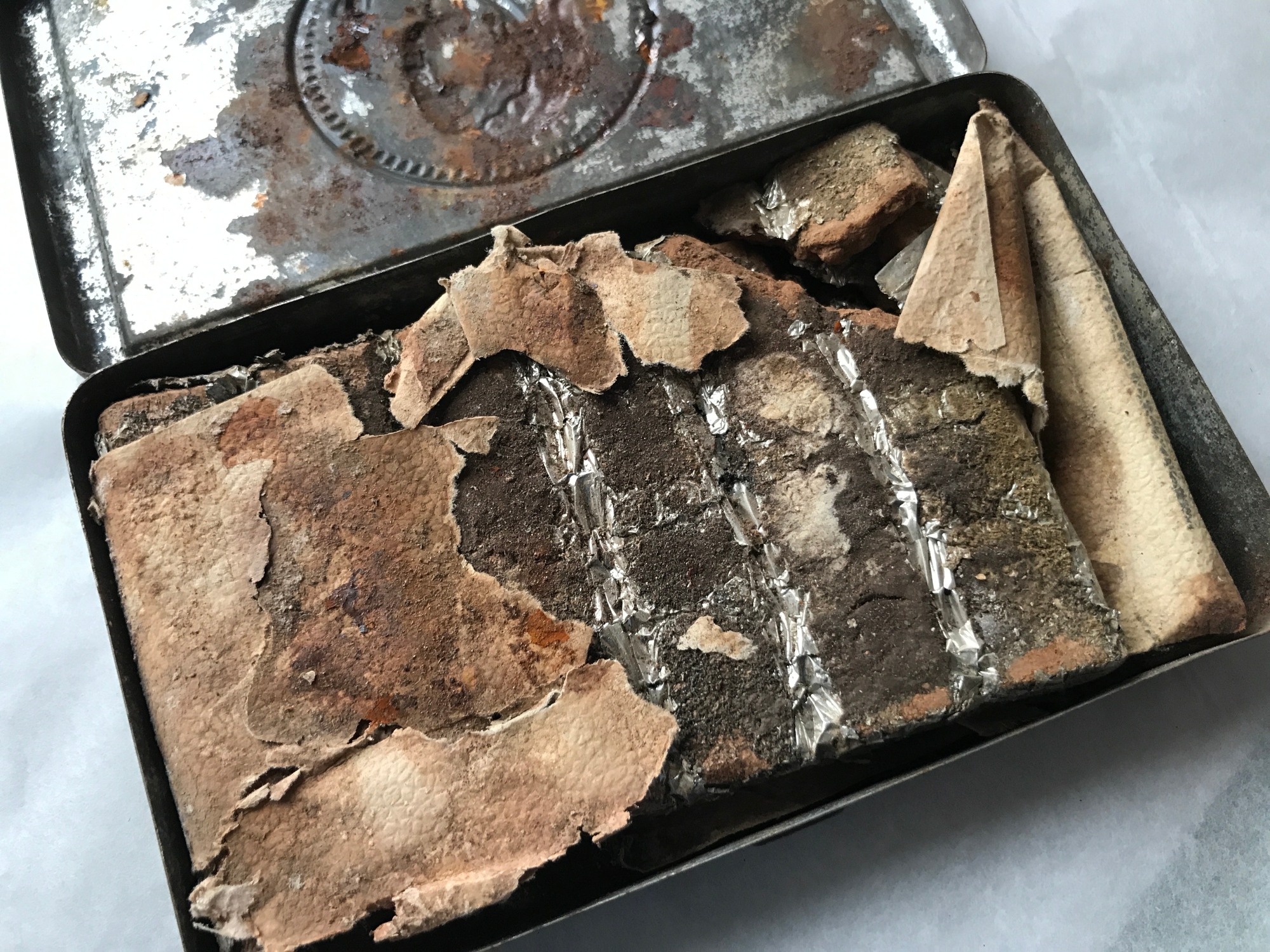
They managed to keep their brands off the tin, but even on that matter the Queen was less than flexible, insisting their names be somewhere on the chocolate or wrappers so the troops would know she was sending them the best British chocolate. The bars/wrappers weren’t all marked, however, and the Oxburgh bar has no surviving brand.
The gesture was popular, and soldiers kept the tins as keepsakes. They do crop up for sale every once in a while, empty tins, mostly, although the chocolate does survive rarely. (Not in any kind of condition to even contemplate ingesting it, of course.) Henry’s bar is an especially rare survival because it is directly connected to the person who received in South Africa in 1900.
NOBEL LAUREATES
The death of Sir Anthony Leggett with his Nobel prize for physics reminds one that Beaumont has another Laureate – Luis Lelior who received the Chemistry accolade in 1970 and I cover his life further on in the article. That the school produced two extraordinary scientists seems remarkable so I looked up were the school stood in the Schools ‘Nobel League Table’.
Well, we come in joint 5th position which might seem moderate till you look at the number of pupils in the other establishments as the table below illustrates:
School Wins Enrolment
1. Clifton 4 1800
2. Eton 3 1300
Harrow 3 830
Westminster 3 780
5. King Edward’s Birmingham 2 825
The Perse 2 1500
City of London 2 1000
U C S Hampstead 2 1100
Winchester 2 740
BEAUMONT 2 250
We still remain the only Catholic school to have Laureates ( though Wimbledon also claim Leggett for his time at the prep-school).
One should also bear in mind that we only had 66 years to produce a winner ( Inauguration 1901) while all the others have so far had 105.
It was written:
“ The remarkable achievements of these schools in nurturing Nobel laureates, highlight their commitment to academic excellence and their ability to inspire ground breaking research and innovation. Their success stories serve as inspiration for current and future students, demonstrating that with the right educational foundation, they too can aspire to make significant contributions to human knowledge and understanding.
Any ‘outsider’ reading this would say that on these results the Jesuits seemed to have closed Beaumont because it was too successful and socially unfair on their other schools!
LELIOR (the man)
Leloir's parents, Federico Augusto Rufino and Hortencia Aguirre de Leloir, travelled from Buenos Aires to Paris in the middle of 1906 with the intention of treating Federico's illness. However, Federico died in late August, and a week later Luis was born in an old house at 81 Víctor Hugo Road in Paris. After returning to Argentina in 1908, Leloir lived together with his eight siblings on their family's extensive property El Tuyú that his grandparents had purchased after their immigration from the Basque Country of northern Spain. El Tuyú comprises 400 km of sandy land along the Atlantic coastline.
During his childhood, the future Nobel Prize winner found himself observing natural phenomena with particular interest; his schoolwork and readings highlighted the connections between the natural sciences and biology. His education was spent in Argentina except for a year at Beaumont in 1920 His grades were unspectacular, and ended quickly when he abandoned his architectural studies which he had begun in Paris.
It was during the 1920s that Leloir invented ‘golf sauce’ whicfh we know better as ‘Marie Rose’ After being served prawns with the usual sauce during lunch with a group of friends at the Ocean Club in Mar del Plata, Leloir came up with a peculiar combination of ketchup and mayonnaise to spice up his meal. With the financial difficulties that later plagued Leloir's laboratories and research, he would joke, "If I had patented that sauce, we'd have a lot more money for research right now."
After returning again to Argentina he obtained his Argentine citizenship and joined the Department of Medicine at the University of Buenos Aires in hopes of receiving his doctorate. However, he got off to a rocky start, requiring four attempts to pass his anatomy exam. He finally received his diploma in 1932 and began his residency in the Ramos Mejía hospital. After some initial conflicts with colleagues and complications in his method of treating patients, Leloir decided to dedicate himself to research in the laboratory, claiming that "we could do little for our patients... antibiotics, psychoactive drugs, and all the new therapeutic agents were unknown at the time."
In 1933, he met Bernardo Houssay who pointed Leloir towards investigating in his doctoral thesis onsuparenal glands. Leloir began working with Houssay, who in 1947 would later win the Nobel prize for Medecine. The two would develop a close relationship, collaborating on various projects until Houssay's death in 1971; in his lecture after winning the Nobel Prize, Leloir claimed that his "whole research career has been influenced by one person, Prof. Bernardo A. Houssay".
After only two years, Leloir received recognition from the medical department at the University of Buenos Aires for having produced the best doctoral thesis. In 1936 he traveled to England to begin advanced studies at the Cambridge under the supervision of another Nobel Prize winner, Sir Frederick Gowland Hopkins,, who had obtained that distinction in 1929 for his work in physiology. Leloir's research in the Biochemical Laboratory of Cambridge centred around enzymes.
Leloir returned to Buenos Aires in 1937 after his brief stay at Cambridge. 1943 saw Leloir marry; Luis Leloir and Amelia Zuberbuhler (1920-2013) would later have a daughter also named Amelia. However, his return to Argentina was amidst conflict and strife; Houssay had been expelled from the University of Buenos Aires for signing a public petition opposing the Nazi regime in Germany and the military government in Argentina. led Leloir fled to the United States where he assumed the position of associate professor in the Department of Pharmacology at the Washington School of Medecine.
Fundación Instituto Campomar
In 1945, Leloir ended his exile and returned to Argentina to work under Houssay again at the Instituto Campomar which Leloir would direct from its creation in 1947. Initially, the institute was composed of five rooms, a bathroom, central hall, patio, kitchen, and changing room. During the final years of the 1940s, although lacking financial resources and operating with very low-cost teams, Leloir's successful experiments would reveal the chemical origins of sugar synthesis in yeast as well as the oxidation of fatty acids in the liver. Along the way, Leloir, unable to procure the costly refrigerated centrifuge needed to separate cell contents, improvised by spinning a tire stuffed with salt and ice.
By 1947 he had formed a team that discovered that in galactosemia, patients lacked the necessary enzyme to convert unusable galactose into usable glucose.
At the beginning of 1948, Leloir and his team identified the sugar nucleotides that were fundamental to the metabolism of carbohydrates, turning the Instituto Campomar into a biochemistry institution well known throughout the world. Immediately thereafter, Leloir received the Argentine Scientific Society Prize, one of the many awards he would receive both in Argentina and internationally. During this time, his team dedicated itself to the study of glycoproteins. Leloir and his colleagues elucidated the primary mechanisms of galactose metabolism (now called ‘the Leloir Pathway’) and determined the cause of galactosemia, that resulted in lactose intolerance.
Losing their main financial backer in 1957, Leloir and his team applied to the Natioal Institute of Health in the United States desperate for funding, and surprisingly was accepted. In 1958, the institute found a new home in a former all-girls school, a donation from the Argentine government. As Leloir and his research gained greater prominence, further research came from the Argentine Research Council, and the institute would later become associated with the University of Buenos Aires.
In his later years Leloir continued to study glycogen and other aspects of carbohydrate metabolism.

Leloir celebrating with colleagues December 10, 1970, after winning the Nobel Prize.
As his work in the laboratory was coming to an end, Leloir continued his teaching position in the Department of Natural Sciences at the University of Buenos Aires, taking a hiatus only to complete his studies at Cambridge and at the Enzyme Research Laboratory in the United States.In 1983, Leloir became one of the founding members of the Third World Academy of Sciences.
Nobel Prize
On December 2, 1970, Leloir received the Nobel Prize for Chemistry from the King of Sweden for his discovery of the metabolic pathways in lactose becoming only the third Argentine to receive the prestigious honour in any field at the time. In his acceptance speech at Stockholm he borrowed from Chrurchill’s famous 1940 speech to the House of Commons and remarked, "never have I received so much for so little". Leloir and his team reportedly celebrated by drinking champagne from test tubes, a rare departure from the humility and frugality that characterized the atmosphere of Fundación Instituto Campomar under Leloir's direction. The $80,000 prize money was spent directly on research, and when asked about the significance of his achievement, Leloir responded:
"This is only one step in a much larger project. I discovered (no, not me: my team) the function of sugar nucleotides in cell metabolism. I want others to understand this, but it is not easy to explain: this is not a very noteworthy deed, and we hardly know even a little."
Legacy
Leloir published a short autobiography, entitled "Long Ago and Far Away" in the 1983 Annual Review of Biochemistry. The title, Leloir claims, is derived from one of William Henry Hudson’s novels that depicted the country wildlife and scenery of Leloir's childhood.
He died in Buenos Aires on December 2, 1987, of a heart attack soon after returning to his home from the laboratory. A friend and colleague of Leloir, claims that his lasting legacy was proving that "scientific research on an international level, although precarious, was possible in an underdeveloped country in the middle of political strife" and credits Leloir's vigilance and will for his ultimate success. With his research in dire financial straits, Leloir often resorted to homemade gadgets and contraptions to continue his work in the laboratory. In one instance, Leloir reportedly used waterproof cardboard to create makeshift gutters in order to protect his laboratory's library from the rain.
Leloir was known for his humility, focus and consistency, described by many as a "true monk in science". Every morning his wife Amelia would drive him in their small Fiat and drop him off at 1719 Julián Alvarez Street, location of Fundación Instituto Campomar, with Leloir wearing the same worn out, grey overalls. He worked sitting on the same straw seat for decades and encouraged colleagues to eat lunch in the laboratory to save time, bringing enough meat stew to share with everyone. Indeed, despite Leloir's frugality and extreme dedication to his research, he was a sociable man, claiming not to like working alone.
The Fundación Instituto Campomar has since been renamed Fundacion Instituto Lelior, and has grown to become an impressive building with 20 senior researchers, 42 technicians and administrative personnel, 8 post doctorate fellows, and 20 Ph.D. candidates. The institute conducts research in a variety of fields, including Alzheimer’s, Parkinson’s and M S.
For the less academic, such as myself, Lelior’s invention of the sauce for the entrée that has been apart of our lives seems more relevant than his contribution to health.
Prawn Cocktail: Tom Parker Bowles
'You shouldn’t muck about too much with a prawn cocktail,’ warn Simon Hopkinson and Lindsey Bareham in their introduction to their retro classic The Prawn Cocktail Years. They’re not wrong. Because this is one great British dish that even the most piscine-averse can embrace with relish.
Sure, the vast majority are sorry shadows of the real thing: mean, tasteless prawn commas, drenched in a lurid slick of ketchup and mayonnaise (shop bought, of course), with a meagre dribble of Tabasco and a dusting of cayenne pepper long past its prime. All dumped atop a tangle of cheap, shredded lettuce and served in a smudged cocktail glass. Flanked, of course, by a meagre wedge of lemon and a few triangles of lustily buttered bread (yum). But, for me, the cheap prawn cocktail is a taste of childhood, seasoned with nostalgia, and a dish that was once as exotic as an entire troop of Nubian dancing girls.
Prawn and cocktail, as I used to think it was called, was, of course, restaurant food, both thrillingly sophisticated and coolly unthreatening. And I ate it wherever it could be found, from the dining room at Claridge’s (where I’m sure it emerged from under a silver cloche) to within the red velvet-lined walls of La Fontana in Pimlico. There was the sweetly sharp comfort of the Marie Rose sauce, pink as a new bride’s negligee, and that satisfying squidge of prawn and lettuce, made all the better by the feeling that you were eating something very grown-up indeed.
I still adore a cheap prawn cocktail, although they are increasingly difficult to find. Thank the Lord, then, for the supermarkets, whose ready-mixed versions I devour straight from the tub.
As was pointed out at the start, it’s best not to mess about with the basics. Or, worse still, ‘reinvent’ the damned thing. There is no place for tiny cubes of tomato in my cocktail sauce, nor raw peppers (urgh!), dill, coriander, cream or, God forbid, tiny slivers of grapefruit. And, as Mr Hopkinson so rightly points out, the ketchup must be Heinz. Nothing else will do.
His recipe also includes cucumber and spring onion, which is reasonable, but a touch too Baroque for my liking. Avocado, on the other hand, is entirely acceptable, as long as it plays a supporting role.
Homemade mayonnaise is always best — and it’s not exactly difficult to make — but Hellmann’s will do just fine. A teaspoon of cognac, or even sherry, is a welcome, if inessential, flourish. Do not, however, overdo the booze. The lettuce should be Cos or Little Gem, using only the tightly furled heart for that all-important crunch. Lime can be substituted for lemon in the sauce, as below, but a dusting of cayenne pepper is always non-negotiable.
Ed: I quite often have one at Wiltons – a trip down memory lane!
Meeting Mother Teresa
by Shaun MacLoughlin | Radio Producer, Author, University Teacher and Actor
In 1986 on my way back to England from producing a BBC Radio history of Australia, I stayed with the brothers of Mother Teresa in the slums of Calcutta. In a church behind Howrah railway station, I set up to record the ordination of 22 Indian brothers. As a man I was required to be on the epistle (right hand) side of the church, while the Sisters of the Missionaries of Charity entered on the gospel side. Although I am short sighted and although the mostly tiny nuns were identically robed in blue and white, I immediately recognised Mother from the stillness and recollection with which she prayed.
Later as we emerged from the church into a courtyard, there was a maelstrom of an Indian crowd. Mother was being ushered into a battered old Padmini and it seemed impossible to get to her. But then a seeming miracle took place . We were whirled through the crush by a vortex and propelled forward to bend over her, as she sat beside the driver. My companion said, “Mother, this is Shaun MacLoughlin from the BBC. He would like to interview you.” I knew that once in New York a member of the paparazzi had asked her, “Mother is there anything in life you dislike?” She answered, “Yes, being interviewed by journalists.” Now she looked me straight in the eye and said, “Bring him to see me to tonight.” With that the car sped off.
That evening we struggled for two hours through the Calcutta traffic to reach the Fort Knox-like Mother House. We rang the old bell and a sister slid open the wicket. It was quite impossible to see Mother, as she was exhausted and anyway later that night she was flying to the Philippines. I said I did not mind how long I might wait, on the off chance. Very grudgingly I was admitted to wait outside Mother’s room in a gallery overlooking the courtyard. There was a tremendous noise of car klaxons, bicycle bells and crows. I wondered whether these would drown out my recording. After another two hours of chatting to a mixed bag of others, who hoped to talk to Mother, an angry and impatient little nun bustled up to me. “Mr MacLoughlin, you wish to interview me?” “Yes please, Mother.” ‘Sit down.” “Is your machine working?” I fumbled with the equipment and the interview commenced. She spoke very quietly and because of the klaxons, crows and bicycles bells, I could hardly hear her. I held the microphone close to her lips. As she talked about the work of the Fathers, of the Active and Contemplative Sisters and Brothers, she was transformed. The Holy Spirit entered her and she was no longer a tired and irritated old woman, but a loving beacon of light. This taught me how all of us human beings, if we pray and surrender to the love of God, can also aspire to be saints, in spite of a seeming mountain to climb. Saints are ordinary people, like you and I, but who are transformed by being open to grace.
At the end of the interview, she looked me straight in the eye again and said, “What about you, Shaun?” She told me at the close of each day to think of the good and the bad I had done to others. She then took my hand and holding each of my five fingers in turn, she told me to say to Jesus these five words, “I did this to you.” She then turned to the next person waiting for her.
I have mislaid the recording, but the interview is written on my heart.
A Piece of SILVER
The original Cowdray Park Gold Cup ( Polo) came up for sale at a local auction House close to Midhurst. One of the 3 x winners was The Duke of Edinburgh who on his first win was assisted by a ‘hired assassin’ – Juan Nelson (49). Juan had brought a team over from the Argentine for the 1957 season and won every tournament they played. The Duke invited Juan to join his team for a tilt at the Country’s most important Polo trophy.
Parent’s Choice.
I recall chatting with the late Nick Warren on an occasion when he told me that he was down to follow his much older brother to Ampleforth from the family home in Cheshire. At the time this mother felt that the Yorkshire establishment was the most prestigious of the Catholic schools. However, on hearing that OB Sir Lewis Clifford Bt was to be appointed Rector of Beaumont and taking into consideration and duty of a parent only to do the very best for their offspring, she felt duty bound to switch allegiance to what she now suddenly discovered was the more eminent college. Nick was forever grateful.
“It was The Sun wot wrote it”
Ed – not my usual choice of reading matter but this came up on my Apple News Feed:-

|
ED: Don’t think I’m going to Legoland but it is handy for both Windsor and ascot racecourses! |
|
CORRESPONDENCE. |
From Christopher McHugh.
You will deservedly receive many emails and letters of thanks and congratulations for the wonderful “Last Hurrah” Garden Party that you, John Flood and the rest of the Beaumont Union committee organised yesterday. I want to add to them with my own very sincere thanks.
The detailed planning and execution that went into such a successful event must clearly have been immense. The production of the booklet - 150th Anniversary Mass and Garden Party – set the scene for a truly memorable occasion.
The order of service could not have been bettered. The choice of starting with G K Chesterton’s famous hymn “O God of earth and altar”, which we had all sung many times in that hallowed chapel, was so appropriate. It’s one of my favourites and the lyrics are very relevant to the times we live in now. It was sung once again with gusto, as indeed were all the other canticles and lauds, unsurprisingly because it is well known that old men’s memories easily recall their youthful days.
The champagne reception with canapés was the opportunity to circulate and meet some long- forgotten friends. The excellent buffet lunch together with Derek Hollamby’s Chateau Beaumont, all under that splendid awning on the Captains’ lawn, was a magical setting. Much thought had gone into the tables and seating plans.
We were blessed with glorious weather, clearly a sign that The Almighty is full of admiration for the work of the Beaumont Union and was not going to allow the occasion to be spoilt by poor weather.
Please pass on my thanks to the whole committee and especially to John Flood who clearly did so much of the organising and let him know that I personally much appreciated his framed photos of the 2nd VIII.
In accordance with the best traditions of the Senior Service, the flag hoist - Bravo Zulu - should be flown from every yard arm for at least week.
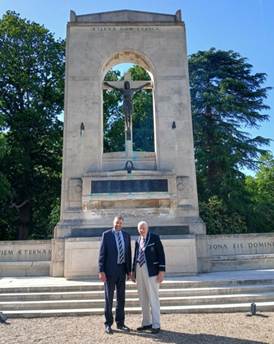
As an aside, throughout their history, Beaumont and St John’s provided many boys who proudly served in the country’s armed forces and, sadly, a great number of them ended up with their names inscribed on our magnificent war memorial. Both Richard and I never fail to go and pay our respects to them whenever we visit Beaumont and I enclose a photo, taken at the recent garden party, of two Royal Navy Captains standing in front of the memorial.
Colin Glennie Initiative
Dear fellow Class of 60,
I am writing to you with a proposal to somehow be part of the celebrations,
though in absentia! Like you, I am unable to attend, being in Denmark.
I wrote to John Flood saying I wanted to send some form of greeting to the
party, so as to be part of the celebration. I suggested there could be others
unable to attend who may have similar thoughts. John kindly replied with
the names of those who have apologised, or who have not responded to the notice
so far. Hence this email to you.
I made two suggestions:
to send a big vase of flowers to be displayed at the event, with a card from
the absent Class of 60; or
to jointly contribute to a charity (HCPT would seem an obvious candidate), with
a card displayed prominently beside the bar at the event showing our solidarity
with event through the contribution.
We have relatively short time to get your responses to a significant level.
For the first suggestion of flowers this would mean an actual
outlay of funds before many will of you will have had time to respond.
But by opening the route to the charity funding, we can announce that such an
initiative has been made and that contributions have already started coming in,
and it means people can contribute later and still be part of the initiative.
Any other ideas?
To move quickly, I suggest we go for the charity option. I will ask John
by copy to announce the funding route to HCPT. I will get the ball
rolling with a contribution and hopefully others will follow. Please let
me and John know that you plan to contribute, or that you have contributed.
No need to state the amount of your contribution, only HCPT will
know that.
Looking forward to hearing from you.
David Fettes
(His apology for not being present at the October Lunch)
Zimbabwe - I’m not a great one for wanting to write about myself, despite yet more near death experiences there a couple of weeks ago.

Apropos your comment about Zimbabwe, the trick with shots like this is to get in, take the shot and out again before the trunk slaps you on the head on its way down.
ED David – it is what we call flying by the seat of your pants ( and probably with a few skid marks as well)
I have actually finished my next book of poetry and am about to try to find a publisher again - I think the last publisher might take it so if I find one I shall send you a copy when it is out. That would be quite enough about me for one decade!
From Romain de Cock
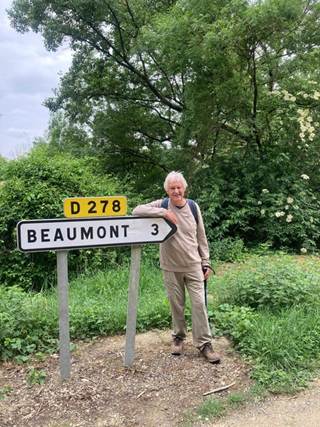
Now that the pictures on the Website have moved to the left I feel emboldened to send you this photo just in the highly improbable case that an acute attack of writer’s block sets in such that you are in need of a filler, no matter how inconsequential, for the next Review.
I have recently walked a part of the Compostela trail together with my brother Kevin who was unfortunate enough to be able to attend Beaumont only for a year before being transported to Stonyhurst.
Industrial amounts of foie gras, duck and armagnac were consumed to the extent that despite the exercise I returned home weighing more than when I left. I am now cutting down on frites and beer to regain some equilibrium. I remain eternally grateful to the Jesuits for having instilled in me the fortitude to face such difficult times of life.
Ed: I was expecting a ‘Michelin Man’ to turn up for the 150th but Romain looked in good shape – a fine advert for the diet which I too enjoyed when living in S W France.
Chris Tailby
I attach the piece on Father Peter Knott SJ and also a “follow on” piece on Catholics at Eton, based on my own experience.
ALSO, in the Review, you mention John Matthew, Senior Prosecuting Counsel. A few years ago, you mentioned him in the Review and I sent you a paragraph on how I was “led” by him when I was a pupil barrister in a murder case at the Old Bailey. I won’t dig it out as it would be “stale news”! …..Unless you want me to!!
Ed. I did:-
Chris Continues:
The mention of John Matthew in the Spring Review took me back to my time as a pupil barrister.
John Matthew was a Senior Prosecuting Counsel at the Old Bailey and the seriousness of the cases he prosecuted and his exalted status meant that he usually appeared in Court with a junior barrister (not a KC) to assist him.
There were a number of Old Bailey Senior and Junior Prosecuting Counsel in the Chambers where I was doing my pupillage and one of the Junior Prosecuting Counsel was briefed to be John Matthew’s junior in a murder case at the Old Bailey.
The Junior in question was engaged in another case so I was told to join John Matthew as a “straw” junior at the Old Bailey. I use the term “straw” because I was not formally instructed as the junior and indeed knew nothing about the case until I joined John at the court. Basically, I was there to pay lip service to the convention that a Senior Prosecuting Counsel is entitled to a junior.
As it happened, I did get to take an active part in the case because when the jury retired to consider its verdict – the question being whether the defendant committed murder or the lesser offence of manslaughter – John turned to me and, rather to my surprise, said, “I’m going back to Chambers, you can stay and take the verdict”. The jury returned a verdict of manslaughter and I had to call the police officer in charge of the case to give evidence of the defendant’s previous convictions prior to sentence.
Fr Peter Knott
Mention of Father Peter Knott SJ as the chaplain to Catholics at Eton reminded me of the time I took my son to Eton for the start of his schooling there in 1995.
Imagine, on arriving at Eton, my surprise at meeting Fr Peter and learn that he was a Jesuit. To say that I did a “double take” is no exaggeration. As I explained to Fr Peter, we sent our son to Eton rather than a Catholic school as I had had two Catholic schools close while I was there and I did not want to risk a third closure, this time with my son. Also, my wife’s school, the convent at Tunbridge Wells, had also closed. I did not think that Eton would close hence the choice. The last person I expected to meet at Eton was a Jesuit. I subsequently discovered that several of my Beaumont contempories had also sent their sons to Eton.
Fr Peter said it would have made more sense to close Stonyhurst, rather than Beaumont, but Stonyhurst had the endowments which meant that the Jesuits would have lost those if they had closed that school.
Fr Peter was an excellent chaplain and arranged for the Catholic boys to be confirmed in the College chapel. He wrote several prayer books (I have two) as well as painting watercolours. He held an exhibition of paintings at Farm Street and I bought a charming painting he had done of a view of a country scene in the South of France.
Catholics at Eton.
Parents of Catholic boys at Eton were asked to join the St Nicholas Society which was the organisation, run by parents, which was set up to fund a catholic chaplain at the College.
At the end of my son’s first year the son of the Chairman of the St Nicholas* Society left the school and a new Chairman was required. A solicitor, Teresa Grant Peterkin took on the role and I became the Secretary/Treasurer. It coincided with Fr Peter leaving the school and Fr David Forrester taking over. Fr David had been an Oxford Don and joined the school staff to teach history. He was paid by the College.
I can’t remember how it came about but Teresa and I had a meeting with the Bursar of the school to discuss the money held by the St Nicholas Society and the contributions made by the parents. He was unaware that parents were paying towards a Chaplain in case the College decided not to pay for one. The Bursar said that he could not imagine any circumstances in which the College would not fund a Catholic chaplain and that the contributions should cease forthwith. He was appalled that in addition to the fees being charged there was the additional contribution. It does, of course, beg the question how, if the Bursar did not know about it, how the request for a contribution got onto the bill but we did not go into that!
Anyway, the upshot was that we had a pot of money which could be used to fund outings for the boys and I believe Fr David used it for various expeditions.
When Teresa’s boy left the school, the next Chairman was Margaret De Wilde whose husband, Robin, was a contemporary of mine when I was at the Bar.
The Society remained active as a forum for Catholic parents and we used to organise an annual dinner to which Catholic masters and of course the Headmaster was invited. One of the after dinner speakers was Charles Moore, the Catholic editor of the Daily Telegraph.
I know that the Society continues as Moira has a cousin whose boys are at the school and she has been involved in the Society. A few years ago, Eton took over a redundant church in Eton for use by the Catholic boys although I think that there are now so many catholic boys that they have outgrown the church!
Fr David Forrester used to say that his ambition was to have as many boys at Eton as had been at Beaumont.
*This
was Ralph Stonor son of Tom Camoys the elder brother of Robert who
was a couple of years ahead of me at Beaumont.
From Richard Sheehan
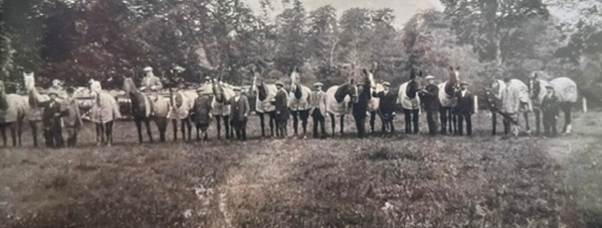
Richard Sheehan’s grandfather’s string of racehorses in Ireland
Ref. silks; I still have my paternal grandfather’s silks registered [indeed I rode in them myself]. They are a plain red jacket with white cap and black spots. My grandmother’s colours were the same, but black cap with white spots. I only registered my grandfather’s because I only ever had one horse per race.
The other [maternal] grandfather’s colours, which my uncle continued to register, were a purple and gold halved jacket with a black cap. That grandfather bred an Irish National winner and both grandfathers bred horses which came second in the National at Liverpool, though my paternal grandfather also bred a horse which won the Scottish National three times. A cousin of my grandmother Richard Vaughan bred Cottage Rake. Those were the days.
Racing : interesting about the Silks and your family connections; I mention Cottage sire of Cottage Rake , Sheila’s Cottage and Lovely Cottage in my Book as Cottage stood at the original Grange Farm/ Stud owned by the Magners ( Evie the daughter of an OB).
On the subject of racing; since I’ve not been in the Duhallow [e.g. Buttevant to Doneraile] area for a very long time and my contacts having now all “passed on”. So, I’m not able to check the details. However, Richard [my grandmother always called him Otty] Vaughan lived as the Vaughans had done at Hunting Hall, at Castletownroche. When he died he left a sum of money to erect a statue to Cottage Rake, however the solicitors somehow never fulfilled that instruction!!
You were right about Cottage, a remarkable sire and the foundation of the Magner family’s very successful breeding history. Though he was bit younger than me, I remember John Magner from Mallow days but in the context of Mallow Rugby Club. All in the past.
As A Follow up Richard wrote:
Meanwhile, what I wanted to say is how much I’m enjoying your latest book. Lots of points arise and one which I will mention is your reference to the Lords Russell of Killowen as the Presidents for two generations of the Pegasus Club [Bar Point-to-Point Club]. I’ve been a member for many years and have ridden in it several times, though my best finish was only third. However, I did win the Heavyweight Cup which is well over 100 years old. It was then run at Fleet Park [as in Mildmay]. A few years ago, I was invited to be President but frankly I’ve never practiced at the Bar and most of my old friends have “passed on”. Nevertheless, I have been asked to host the annual Dinner this year at the Turf, so that’s a minor involvement.
From John Joss ( J2)
( John has just celebrated his 92nd Birthday at his home in Mountain View , California))
I owe my professional life and career to Fr. Bernard Basset, S.J.,
who taught me how to write.
To Fr. Boyle, for his strict discipline, matched by compassion.
To Fr. Ferguson, for teaching me stoicism in the face of pain
(his application of the ferula to my palms). He thus imbued in me
a loathing for authority (cured by the Royal Navy).
To Mr. Sinclair for teaching me maths, lifelong power.
And for all my fellow students, for being companions, especially
in rowing.
From Tony Waldeck (57)
( following a comment from the Ed that he might be getting marooned across the Tamar)
As you say, becoming marooned! However, I have Colin Drummond with whom to have fun. 2 years older than me but full of energy and vivacity. We play bridge regularly, but next week he'll be "off the case" visiting his brother who will be 90. This bro is also an old BU but before my time. Colin was a wonderful oarsman but insists his sibling was "much better". Drummond snr retired as a Brigadier. Their papa had been an Army medical officer, serving in Egypt before WW2 - and the brothers were born out there. Colin is another Great Man, close to my heart for his significant contribution to ocean Yacht Racing - which, with golf is what I spent most of my life having wonderful times!
ED:I have since heard that Paul Burden is moving from the Thames Valley to ‘Lorna Doone’ country. I trust that he will not be lost to us!
L. D. S.